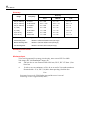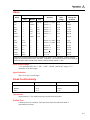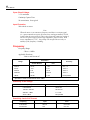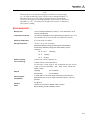
1
45
Users Manual
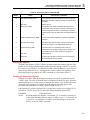
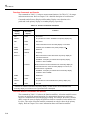
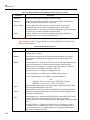
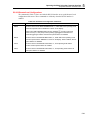
The default meter setting is: volts tic, autoranging, secondary display inactive. A
different power-up configuration can be set by pressing S and E at the same
time; the present configuration of the meter then becomes the power-up
configuration.
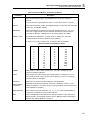
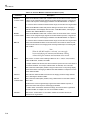
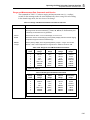
A description of message exchange options:
5A. The size and behavior of the input buffer.
The input buffer size is 350 bytes. If the input buffer fills, the IEEE-488.1 bus will be
held off until there is room in the buffer for a new byte.
5B. Which queries return more than one <RESPONSE MESSAGE UNIT>, Section 6.4.3.
The *IDN? query always returns four<RESPONSE MESSAGE UNITS>. The CAL?
and MEAS? queries may return one or two <RESPONSE MESSAGE UNITS>—one
if only the primary display is in use, two if both the primary and secondary displays
are in use.
5C. Which queries generate a response when parsed, Section 6.4.5.4.
All queries generate a response when parsed.
5D. Which queries generate a response when read, Section 6.4.5.4.
No queries generate a response when read by the controller.
5E. Which commands are coupled, Section 6.4.5.3.
No commands are coupled.
6. A list of functional elements used in constructing device-specific commands.
Whether <compound command program header> elements are used must also be
included, Section 7.1.1 and 7.3.3.
Device-specific commands used:
<PROGRAM MESSAGE> <PROGRAM MESSAGE TERMINATOR> <PROGRAM
MESSAGE UNI T> <PROGRAM MESSAGE UNIT SEPARATOR> <COMMAND
MESSAGE UNIT> <QUERY MESSAGE UNIT> <COMMAND PROGRAM
HEADER> <QUERY PROGRAM HEADER> <PROGRAM DATA>
<CHARACTER PROGRAM DATA> <DECIMAL NUMERIC PROGRAM DATA>
7. A description of any buffer size limitations related to block data, Section 7.7.6.5.
No block data is used.
8. A list of <PROGRAM DATA> elements which may appear within an <expression>
as well as the maximum sub-expression nesting depth Any additional syntax
restrictions which the device may place on the <expression> shall also be included.
No sub-expressions are used. The only <PROGRAM DATA> functional elements
used are <CHARACTER PROGRAM DATA> AND <DECIMAL NUMERIC
PROGRAM DATA>.
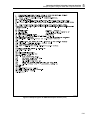
9. A description of the response syntax for every query, Section 8.
RATE?, FUNC1?, FUNC2?, RANGE1?, RANGE2?, BUTTON?, EEREG?, DBREF?,
HOLDTHRESH?, RELBASE?, *ESR?, *SRE?, *TST?, and *OPC? all return <NRI
NUMERIC RESPONSE DATA>.
FUNC1?, FUNC2?, COMP?, and SERIAL? all return <CHARACTER RESPONSE
DATA>.