1
APPLICATION NOTE 008
RF RECEVER SENSITIVITY
PREFORMING VALIDATION
LTRSSI – Long term RSSI, a measurement to determine the ambient power levels of the
frequency used in the DUT.
Trigger Telegrams – 1BS telegrams with 0xBE as the data byte. These trigger the DUT to
transmit RSSI VLD debug telegrams.
Transmit Gateway – RF isolated gateway that will be sending trigger telegrams to the DUT
via Dolphin View Advanced.
Receive Gateway – Gateway that will be receiving VLD debug telegrams from the DUT via
Dolphin View Advanced.
1.5 Theory
In order for an RF signal to be received it needs to be detected, and then decoded. By
measuring ambient wireless power levels the receiver can detect the beginning of transmission, when the input power level increases across a threshold. During times when no
transmissions are occurring this power level is known as the noise floor, or long term receive signal strength value. It represents the power received from emitters other than the
intended transmitter.
If the power at the receiver has a sudden increase for a sustained time the receiver can
attempt to decode this as a valid signal. The successful decoding of a radio telegram depends on the ratio of the power of the signal to the power of the noise (SNR) at the receiver during reception. If the SNR is large the noise will have little influence on the probability
of correct bit detection. If there is a significant noise level relative to the signal, and thus a
small SNR, the probability of decoding bits correctly decreases. To maximize the power received good RF layout and antenna design practices should be followed. Limiting the noise
is more complicated.
Without noise a receiver could correctly decode a signal that arrives at the tiniest power
level and wireless signals could be received at very long distances. Many noise sources exist at the lowest level of physics and cannot be mitigated. The most significant noise source
is thermal noise because it is constant over time and exists at every frequency. This noise’s
power level is a function of the devices temperature and the bandwidth of the receivers
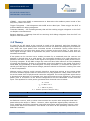
input. The equation for noise power generated from thermal noise is below.
Freq:
315MHz
868MHz
902MHz
-119.1
-119.1
-119.1
Table 1 - Noise Floors
An EnOcean receiver, with no other noise sources can receive radio telegrams that have
power above the values in Table 1. However, other significant signal quality reducers do
exist; amplifiers and filters introduce noise and attenuation while decoders require a minimum power above the noise floor. This allows us to arrive at the operating noise floor of
EnOcean receivers.
© EnOcean | www.enocean.com
Subject
Subject
to modifications
to modifications
| Wolfgang
| Bryan Edelman
Bihlmayr | January 2013 | Page 3/ 14