1
THE TEN COMMANDMENTS OF FIREARM SAFETY
The Ten Commandments of Firearm Safety should
be etched in your memory forever. Let them govern
your action wherever and whenever you’re involved
with firearms, in the field, on the range, or in your
home. Please take the time to review and understand
these rules.
1st COMMANDMENT
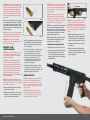
ALWAYS KEEP THE MUZZLE POINTED IN
A SAFE DIRECTION.
This is the most important firearm safety rule. A safe
direction is one in which an accidental discharge will
not cause injury to yourself or others. Never allow
your firearm to point at anything you don’t intend to
shoot. Be especially careful when you’re loading or
unloading. Treat every firearm as if it were loaded.
Make it a habit to know where the muzzle is pointed
at all times, even when your firearm is un-loaded. No
one will be injured by an accidental discharge if you
keep your firearm pointed in a safe direction. It’s as
simple as that.
2nd COMMANDMENT
FIREARMS SHOULD BE UNLOADED WHEN NOT
ACTUALLY IN USE.
Load your firearm only when you’re in the field or on
the target range and ready to fire. Never let a loaded
firearm out of your sight or out of your hands. Unload
it as soon as you’re finished shooting - before you
bring it into your car, camp or home. Remember,
unloading your firearm means unloading it completely,
so there is no ammunition in the chamber or in the
magazine. Before handling a firearm or passing it to
someone else, visually check the chamber, receiver
and magazine to be certain they do not contain
ammunition. Always keep the firearm’s action open
when not in use. Never assume a firearm is unloaded
even if you were the last person to use it. Always check
for yourself.
• Let common sense rule when you carry a loaded
firearm. If you’re in a situation that could risk
accidental discharge - such as crossing a fence,
wading through a stream or climbing a tree - always
unload your firearm. Never pull or push a loaded
firearm toward yourself or another person. Never
carry a loaded firearm in a scabbard, detached
holster or gun case.
AAC — BLACK RIFLE MANUAL
• Certain firearms are equipped with internal security
devices to prevent unauthorized use. In addition,
some firearms owners use external devices, such as
cable locks and trigger blocks, for the same purpose.
Even if you use such a device, you should still keep
your firearm unloaded when stored or not in use. And
using internal or external devices cannot substitute,
however, for securing your firearms and ammunition
in a separate, locked location.
• Safe storage of firearms is just as critical as safe
handling. Never store firearms loaded. Be sure
to keep your firearms in a secure place where
unauthorized persons cannot get their hands on them
without your knowledge.
• Take special care if there are children around.
Children are fascinated by firearms. It’s a natural
curiosity that can have tragic consequences when not
properly supervised. Store your firearms in a locked
gun safe or some other location that physically bars a
child from gaining access.
• Ammunition should be stored and locked in a location
separate from your firearm. Never leave an unsecured
firearm or ammunition in a closet, dresser drawer
or under the bed. Remember, it is your responsibility
to make sure that children and others unfamiliar
with firearms cannot get access to your firearm and
ammunition.
3rd COMMANDMENT
DON’T RELY ON YOUR FIREARM’S SAFETY
Treat every Firearm as if it can fire at any time, whether
or not there’s pressure on the trigger. Your firearm
has been carefully designed to maximize performance
and safety. However, because a firearm’s safety is a
mechanical device, it could fail.
Human error is a more likely reason for a firearm safety
to fail. By mistake, you may think the safety is on when
it really isn’t, or the safety may have been disengaged
without your knowledge, or you could think your
firearm is unloaded when there’s actually a cartridge
or shell in it. A mechanical safety is not a substitute
for common sense. It’s merely a supplement to your
proper handling of a firearm.
Never touch the trigger on a firearm until you are ready
to shoot.Keep your fingers away from the trigger when
you’re loading or unloading. And don’t pull the trigger
when the safety is engaged or positioned between
safe and fire.
Before using your firearm, read this instruction book
to understand the exact location and operation of
your firearm’s safety. Even when the safety is on,
maintain control of your loaded firearm and control
the direction of the muzzle. In other words, don’t rely
on your safety to justify careless handling. If your
firearm’s internal mechanisms are broken or have been
altered, your firearm may fire even when the safety
is on. Remember, you and your safe firearm handling
practices are your firearm’s best safety.
4th COMMANDMENT
BE SURE OF YOUR TARGET AND WHAT’S BEYOND IT.
You can’t stop a shot in mid-air, so never fire unless you
know exactly where your shot is going and what it will
strike. Never fire at a sound, a movement or a patch of
color. A hunter in camouflage can easily be mistaken
for a target by an impulsive shooter. Before you pull
the trigger be absolutely sure of your target and what’s
behind it. Make sure the shot has a backstop such as a
hillside or dense material like sand. Remember, bullets
can travel great distances with tremendous velocity.
Know how far your shot will go if you miss your target or
the bullet ricochets.
5th COMMANDMENT
USE PROPER AMMUNITION
Every firearm is designed to use a certain caliber or
gauge of ammunition. Using the wrong ammunition,
mixing ammunition or using improperly reloaded
ammunition can cause serious personal injury or death.
It only takes one cartridge or shotshell of the incorrect
caliber or gauge, or which has been improperly
reloaded, to destroy your firearm.
It’s your responsibility to make sure the ammunition
you use exactly matches the caliber or gauge of your
firearm. Refer to this instruction book to find out the
specific requirements of your firearm. Always read and
heed the instructions on ammunition boxes. Confusing
shells or cartridges can cause serious personal injury
or death and destroy your firearm. Examine your shells
or cartridges closely and use only the precise caliber or
gauge for your specific firearm. For example, suppose
you accidentally loaded a 20 ga. shell into a 12 ga.
shotgun. Because the 20 ga. shell is too small for the
chamber, the 20 ga. shell could travel down the barrel
and get lodged in the bore.
If you then loaded a standard 12 ga. shell behind it and
fired, the 12 ga. shot will slam into the lodged 20 ga.
shell and may cause the barrel to explode right in your
hand. This is commonly called a 12/20 burst, and it can
kill you.
Check all ammunition before you load it to make
sure it matches your firearm’s requirements. Every
Remington® and Barnes Bullets cartridge and shell
is head-stamped with its caliber or gauge for easy
identification. Likewise, you’ll find the caliber or gauge
of your new AAC firearm imprinted on the barrel.
RELOADING REQUIRES EXTRA DILIGENCE.
If you’re an ammunition reloader, you are responsible
for personally assuring that the loads and components
of your reloaded ammunition meet your firearm’s
factory-tested standards. Never use ammunition, which
has been reloaded by someone else!
Many shooters handload as a hobby or to save money
on commercial, factory-made ammunition. However, it
requires a thorough knowledge of reloading procedures
and a deep respect for the explosive potential of
gunpowder.
Firearms are designed, manufactured and proof-tested
to standards based on factory-loaded ammunition.
Handloaded or reloaded ammunition that deviates,
either intentionally or accidentally, from load or
component recommendations can be very dangerous.
Reloaders must observe all possible safety precautions
and practices related to the proper handling of
explosives. Whether you’re a seasoned reloader or
just starting out, you should study the subject, watch
reloading demonstrations and talk to experienced
reloaders.
The first rule of reloading is to always follow the
manufacturer’s instructions for the components
you’re using. They’ll tell you to follow certain
guidelines. Namely:
1. Don’t mix or substitute powders or primers.
2. D
on’t use unknown or substandard components.
3. U
se only suitable components that have been
factory-tested by reputable ammunition, powder and
bullet manufacturers.
4. Always be sure to use the manufacturer’s
recommended recipe when reloading.
Not following these guidelines could result in severe
injury to yourself or severe damage to your firearm.
Dangerously high pressure and explosions can result
3