1
US 8,701,186 B2
11
12
that are never assigned to the variables a and r, since the string
the string analysis has been implemented on top of a static
analysis completely ignores the condition of the “for” state
analysis framework. The static analysis framework employed
ment.
may be any known framework and may include, for example,
When the application code uses prede?ned string opera
tions, such as String.substring as shown in the following
the Watson Libraries for Analysis (WALA), available as an
5
portion of application code, a sound approximation is used for
open source product from wala.sourceforge.net.
To describe the intra-procedural string analysis, consider
every string operation to translate a application code into a
the nappend method in JavaTM which is as follows:
CFG. For example, consider the prede?ned string operation
in the following portion of code:
String aI“xxa”;
public class MyClass {
static public void main(String args[ ]) {
String r:a.substring(2);
String a = “a”; String b = “b”;
Soundness of the approximated string operation means that a
String r = nappend(a, b, 3);
resulting CFG computed by the approximated string opera
tion contains all the actual strings computed by a prede?ned
public void nappend(String x, String y, int n) { String r = null;
if (n == 0) {
string operation that corresponds to the approximated string
r = x;
operation. One of the methods to approximate the prede?ned
}
string operation is to use a transducer which is an automaton
else {
with output.
Soundness may be formally de?ned as follows; f is a sound
r = nappend(x + y, y, n—l);
20
approximation for a string operation f iff S'Cf_(S) where
S":(s'|s':f(s), seS). One of the methods to ap?ximate pre
de?ned string operations is to use a transducer which is an
automaton with output. It is well known that the image of a
transducer is also a CFG. Other methods are homomorphisms
on Q, +) where Z is a set of characters and + denotes concat
25
In block 502, a translation of a program is made into Static
Single Assignment (SSA) form, where pseudo notations are
used for instructions. An example, translation is illustratively
enation functions that always return the same CFG yielding
shown as follows:
all the possible strings returned by corresponding prede?ned
string operations, and so on. The following production rules
with the approximated string operation substring(i,2) are the
ones obtained from the example portion of app ication code
return r;
main(String)
30
2. bI“b”
3. rInappend(a, b, 3)
above by using sound approximation:
nappend(String)
Srqubstring(Sa,2)
35
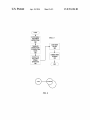
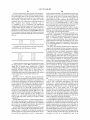
Referring now to FIG. 4, a transducer 400 is illustratively
. rl :nappend(v l, y, n— 1)
depicted. An approximated string operation substring(i,2) is
goto 8
de?ned by the transducer 400 and is a sound approximation
for the string operation substring(i,2). By applying the
depicted transducer 400 to the grammar consisting of the
above production rules, one can obtain the following CFG
goto 8
40
9. return r
which represents the set {"a",“aa”,“aaa”,“aaaa”, . . .
A call graph for this program is depicted in FIG. 6. Pseudo
notations used for instructions in the above program include
S'aQa
45
va/al for an assignment of a value val to a variable or a ?eld
The symbol A in FIG. 4 represents any character while A/e
v, v:obj.func(vl, . . . , vn) for a method invocation with
represents a transformation of any one character to the empty
arguments v 1, . . . , vn, goto N for an unconditional jump to the
string, which means removing the character. With a “sound”
transducer, the resulting abstract value is a safe approxima
tion of the strings that may result from the operation at run
50
time. Thus, for “substring(i,2)”, the representation simply
removes the ?rst two characters in the string, as indicated by
the labels A/e (essentially removes character A). A new CFG
is obtained which results from applying the transducer to the
original grammar.
data dependencies.
In block 504, the assignments in SSA form are translated to
55
After iteratively applying the above mechanisms to the
application code, a set of product rules representing the appli
described above (See FIG. 1 above). In particular, vrphi(vl,
v2) is translated into two production rules SVQSVl and
SVQSV2 so as to make it represent a union of the two sets of
60
Referring to FIG. 5, one illustrative embodiment will now
SleSxSy
be described for implementing a static string analysis in
accordance with the illustrative embodiments. The descrip
then explains how to extend that to inter-procedural string
analysis. The implementation details presented assume that
strings assigned to v1 and v2, respectively. According to this
translation, one can obtain the following production rules
from the pseudo SSA form of the nappend method.
s1s.
tion provided deals with intra-procedural string analysis, and
a set of production rules with string operations 506, except for
conditional and unconditional jumps, in the same manner
cation, but in which no string operations are present, is
obtained. Thus, a context-free grammar consisting of the
resulting production rules is the outcome of the string analy
label N, goto N if v for a conditional jump to the label N by the
condition v. In addition, the SSA transformation introduces
new variables and a (ID-function, which is denoted by phi(vl,
v2), to yield a program which has only one assignment to each
variable. This characteristic of the SSA form is suitable to ?nd
65