1
ical dynamics of the quantity being measured by added
appropriate weights to the previously computed average,
and the current sensor measurement (weighted moving
average). The moving average is a common method for
filtering sensor data [12] [18] [19] [20].
Average: Applications, such as sensor networks, often
measure physical quantities over a distributed area (e.g.
temperature). Averaging these distributed measurements is
a simple means for aggregating this information into a
compact form. This approach was used by Goebel [13],
Ganeriwal [21], and Nakamura [22]. In [12] Hellerstein
uses averaging as means of “cleaning” data obtained from
a group of sensors.
Delta Value: Often, the difference between the current
and previous value of the sensor (called delta) is used in
a lot of computation. eg: the “communication” suite of
benchmarks in [3] includes delta modulation, a process
of encoding which may be used to encode the output of
sensors before transmission. [15] presents another example
of using the “delta” value in a sensor based system.
Threshold/Range Check: There are various applications
in which the sensors values are required to be within
particular range or below/above a certain threshold for
the proper operation of the system. In such systems, some
sort of mechanism is needed to monitor the sensor values.
Alternatively, the systems might need to take some kind
of action when the sensor value breaches the defined
range/threshold bound.
This is by no means an exhaustive list of such kernels,
but having identified some common kernels of computation
across fields, in the next section we propose a unit, the
SPU, which could be a part of the architectures of future
embedded processors.
IV.. S ENSOR P ROCESSING U NIT (SPU) A RCHITECTURE
This section presents our lightweight mechanism for
sensor processing. First we provide and overview of the
SPU and some possible applications. Then we describe its
architecture. Finally we describe the development platform
and the prototype limitations.
A. Overview
The SPU is designed to be a functional unit within
an embedded processor. It has two main purposes 1)
to efficiently offload the execution of common sensor
processing tasks from the main ALU, and 2) to detect
events that are a function of sensor values. Here we discuss
the two major uses of the SPU, and how it could potentially
be used for power management.
Sensor Processing Offload: The SPU has been designed
to operate in the following manner. First a user application
programs the SPU with functions that need to be performed
on the output of one or more sensors. Once programmed
the SPU computes these functions continuously as sensors
data flows into the SPU. The output of the sensors are
directly connected to the SPU, thus the SPU reevaluates
its programmed functions autonomously of the rest of the
processor. When the user application requires the result of
one of the programmed function, it simply issues a single
instruction to fetch this value from a special register. This
is opposed to the traditional approach of 1) reading all
sensor values required by a function, and 2) computing the
function in software. In addition to increasing the speed at
which a given sensor processing function can be computed,
discussed in Section V, the SPU allows the rest of the
processor to focus on other tasks.
Event Detection: Each function programmed into the
SPU can have an event associated with it. An event checks
if the result of a given function is <,>,or = to a fixed
value, or if the result of a function is within or outside
a given range. It the associated condition is true then an
interrupt is sent to the main processor. The purpose of this
functionality is to allow the processor to work on other
tasks until a given event fires off, as opposes to having to
continuously poll sensor values and compute this event
checks in software. This capability targets application
that need to take actions when sensor values surpass a
given threshold (e.g. thermal shutdown condition), or fall
outside a acceptable range (e.g. voltage supply stability).
As indicated in Section II, current processors do have the
ability to react to simple events such a thermal overload.
The SPU is a lightweight means to generalize the type of
events that a processor can detect and respond to.
Power Management: Again, as discussed in Section II,
many processors and microcontrollers support a low power
mode from which they can be woken up by an interrupt. Given the SPU’s ability to operate on sensor data
autonomously of the rest of the processor, the SPU could
potentially be used as a lightweight mechanism that allows
the rest of the processor to go into, or come out of a low
power state based on sensor data.
B. Architecture
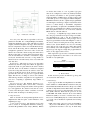
In this section we discuss the architecture of the SPU,
which is made up of five major component: Sensor Data
Extractor, Configuration Storage, Processing Unit, Result
Storage, and Interrupt Generator. Figure 2 illustrates the
architectural layout of the SPU.
Sensor Data Extractor: This block is responsible for
connecting the SPU to available sensors. It continuously
streams sensor data to the SPU’s Processing Unit, and
Interrupt Generator.
Configuration Storage: This is where configuration
information sent by a user application is stored. This
information includes the set of sensors a given functions
operates on, the operations and constants that define a
function, and threshold and range values associated with
events that can generate interrupts to the main processor.