1
1. Introduction
There are two distinct applications related to the aircraft icing problem in which computational fluid dynamics (CFD) can play a significant role [1]. First is the prediction of ice accretion using a code such as
LEWICE [2] coupled with a CFD flow solver. The second potential application is a detailed flow field
analysis to determine the effects of ice accretion on aircraft performance. Here, we focus exclusively on the
second application.
In general, detailed three-dimensional simulations of the flow around an iced wing are relatively rare due
to the enormous expenditure of resources needed to obtain a quality solution. Chung, et. al. [3] demonstrated
the potential of CFD by predicting the aerodynamic characteristics of an aircraft involved in an accident
attributed to icing. The ice shapes were determined from tests in the NASA GRC Icing Research Tunnel.
Once a representative two-dimensional chordwise sections was discretized, a three-dimensional geometry
was generated by extruding the two-dimensional ice shape in the spanwise direction and fairing the shape
at the tip. A two-block structured grid was generated with noncontiguous overlapping interfaces. The flow
field solution was computed using the general-purpose code NPARC [4].
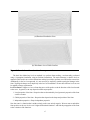
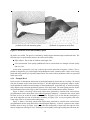
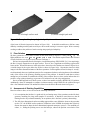
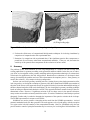
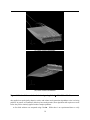
Recent advances in scanning technology have made it possible to generate descriptions of complex
shapes in the form of “point clouds.” This technology has been exploited to generate three-dimensional
point-cloud data for iced wing configurations [5]. Although scanners typically employ a preset scan pattern,
the resulting data can perhaps be best characterized as unorganized because the only connectivity information is in terms of the scan line. Further, the data obtained from a scan may be noisy. Existing techniques
depend solely on geometric characteristics to reconstruct a surface and may have difficulty reconstructing a
nonsmooth surface from noisy data [6].
The ability of geometry/mesh generation tools to adequately address the unique needs of an iced wing
flow simulation is also much in question. Obviously, there are significant issues related to representation of
the iced wing surface. There are also questions regarding the quality of the NURBS representation of the
surface. It is obvious that some preprocessing of the surface will be required. However, there is no clear
indication at this time what type of preprocessing is needed or to what degree it is needed. Additionally,
within the constraints of accuracy, efficiency, and flexibility, questions remain as to what type of mesh is
appropriate for a complex iced-wing configuration.
In this report, we focus on activities associated with the first year of a three-year program to develop a
software package to facilitate the numerical simulation of viscous flows around iced wing configurations.
To date, there have been only limited numerical three-dimensional icing-effects studies. Due to this limited
experience, the first year emphasis was placed on identifying a sound, overall approach to surface mesh generation/volume mesh generation/flow solution rather than developing new technologies. The one exception
to this is the development of a generalized, near-body mesh generation module. Below is a brief summary
of activities accomplished to date:
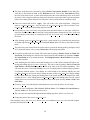
1. An approach to generate a fully three-dimensional NURBS representation of the point-cloud data was
developed using the “Imageware Surfacer” software package.
2. An approach using a pseudo three-dimensional lofted geometry representation with the “Imageware
Surfacer” software package was investigated.
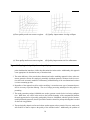
3. A technique utilizing medical imaging technology was applied to filter chordwise iced-wing sections.
The approach met with mixed, although promising, results.
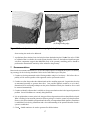
4. Several meshes for iced wing configurations were developed using the existing mesh generation package SolidMesh [7].
5. A new topologically-adaptive surface mesh generation algorithm was applied to the iced wing problem.
1