1
6. A new topologically-adaptive volume mesh generation algorithm was applied to the iced wing problem.
7. A flow solution for an iced wing configuration was generated using the Cobalt [8] flow solver.
8. Strategies were developed for geometry modeling and mesh generation specific to the iced wing
problem.
The work accomplished to date can best be divided into three categories–geometry modeling, mesh generation, and flow solution–and the report is organized in this manner. A summary of activities relevant to
each of these areas performed during Year 1 is described in the sections that follow. Also included are a
discussion on the implications of the work and a suggested strategy for iced wing CFD.
2. Problem Description
The problem of generating a computational fluid dynamics solution for the flow about an iced wing is a
complex one involving several steps. In order to provide motivation for the organization of this report, we
now provide a problem definition. Given a point cloud representation of a wing with an ice accretion:
1. Develop a representation of the surface that is suitable for generating a surface mesh
2. Specify the artificial boundaries needed to define the computational domain, e.g., outer boundary,
wake, etc.
3. Generate a mesh and specify boundary conditions on the bounding surfaces of the computational
domain
4. Generate a mesh in the interior of the computational domain
5. Generate a flow solution
Since our objective is to develop a strategy to solve this problem, the problem statement is expressed in
terms of an implementation strategy. In the sections that follow, we will focus on issues relating to geometry
modeling and mesh generation. We also provide a flow solution to demonstrate existing capabilities.
3. Geometry Modeling
In this context, the objective of geometry modeling is to generate a NURBS representation of the iced wing
from the scanned point cloud data. This NURBS representation is then output as an IGES file which can
be used as input to a mesh generator. The primary challenge associated with the geometry modeling is a
reconstruction of potentially noisy surface data. The software used to generate the geometry description is
the SDRC package “Imageware Surfacer” hereafter referred to simply as Surfacer. We acquired Surfacer
under the SDRC University Licensing Program. S. Chalasani and S. Gopal took part in a training program
on “Imageware” conducted by SDRC April 16-20, 2001.
We first describe issues related to surface modeling. We then describe two different techniques to generate a NURBS representation of the point cloud data. Finally, we discuss an automated filtering procedure
based on techniques from medical image processing.
3.1 Surface Modeling
Advances in scanning technology have provided impetus for cataloging and characterizing three-dimensional
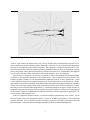
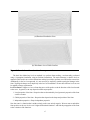
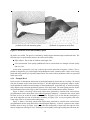
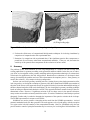
ice accretions on aircraft wings. Shown in Figure 1 is a side view of a typical “noisy” point cloud. In addition to obvious “outliers,” there are points relatively near the surface that are clearly not part of the surface.
It should be noted that the points near the leading edge that appear to be “inside” the airfoil are actually in
2