1
Health, Safety and Wellbeing Handbook
SAFE OPERATING PROCEDURE
LOCATION DETAILS
School/Branch: Adelaide Microscopy – Basement Medical School North
SAFE OPERATING PROCEDURE DETAILS
Date prepared:
PALM LASER MICRODISSECTION AND PRESSURE
CATAPULTING (LMPC)
20/ 05 /13
PREPARED BY Name, Position and Signature (insert names of the supervisor, HSR, HSO and operator involved)
Name
Ruth Williams
Position
Microscopist
Signature
RISK ASSESSMENT
Has a risk assessment been completed and
have all other environmental considerations
been made?
Yes
See Risk Assessment dated:
/
Risk Rating:
/
No
Low
Medium
High
Very High
SAFE OPERATING PROCEDURE DETAILS
Procedure (Include control measures listed in risk assessment within the procedure):
Pre-operational Checks
Operational Checks
The Palm laser microdissetion and pressure catapulting instrument (LMPC) IS A LASER DEVICE OF Class 1 M. Built
in is a pulsed UVLaser of class 3B. It bears a potential risk. A direct or reflected beam must not strike the unprotected
eye ( do not look directly into the beam).
Under no circumstances is the user entitled to open the laser unit. The laser system is encapsulated and may only be
repaired or exchanged by authorised personnel. Improper use of the laser may lead to injury.
There is a risk of injury if using other operating or adjusting equipment or other methods than those described in the
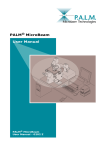
Palm Microbeam User Manual located on the bench next to the LMPC.. The user may be exposed to dangerous
radiation.
HSW Handbook
Authorised by
Warning
Hazard Management
Effective Date:
11 February 2010
Vice Chancellor and President
Review Date:
February 2013
This process is uncontrolled when printed. The current version of this document is available on the HSW Website.
Version 1.1
Page 1 of 2
All observation ports are equipped with UV shields.
The only user operable parts on the Palm Laser Microdissection System are the microscope,
robostage, control unit, collection device holder, and the computer system (mouse and
keyboard). There is no risk involved in the operation of these parts. However, misuse of these
parts can result in damage to the instrument. All new users must have a practical
demonstration of the operation of the machine from a trained member of Adelaide
Microscopy (AM) staff. Users should operate the instrument in accordance with the
manufacturer supplied operating instructions to avoid damage to the instrument. The user
operable parts are all accessible from the operator’s console: users of the instrument should not
access the rear of the instrument. Nor should they attempt to remove any fixture or panel from the
microscope.
Handling of biological material may present some safety problems and the safe operating
procedure for handling animals and biological material must be followed. The safe handling of
general laboratory items is detailed in the Adelaide Microscopy laboratory general safety
procedures. Low stocks of consumable items (gloves, paper towel, etc.) should be reported to a
member of AM staff.
On completion of work
Note: This Safe Operating Procedure must be reviewed :
a) after any accident, incident or near miss;
b) when training new staff;
c) if adopted by new work group;
d) if equipment, substances or processes change; or
e) within 5 years of date of issue.
HSW Handbook
Authorised by
Warning
Hazard Management
Effective Date:
11 February 2010
Vice Chancellor and President
Review Date:
February 2013
This process is uncontrolled when printed. The current version of this document is available on the HSW Website.
Version 1.1
Page 2 of 2