1
21
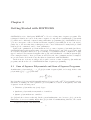
3.4. ADDING CONSTRAINTS
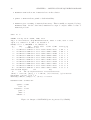
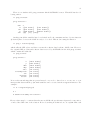
>> R(2,1)
ans
coeff_11*x1^2 + coeff_12*x1*x2 + coeff_13*x2^2
>> R(2,2)
ans =
coeff_14*x1^2 + coeff_15*x1*x2 + coeff_16*x2^2
In the next section it will be shown how these matrix variables can be incorporated as constraints
in sum of squares optimization problems.
3.4
Adding Constraints
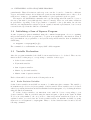
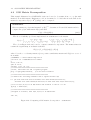
Sum of squares program constraints such as (2.3)–(2.4) are added to a sum of squares program
using the functions soseq and sosineq.
3.4.1
Equality Constraints
For adding an equality constraint to a sum of squares program, you must use the function soseq.
As an example, assume that p is an SOSP variable, then
>> Program9 = soseq(Program9,diff(p,x)-x^2);
will add the equality constraint
∂p
− x2 = 0
∂x
(3.5)
to Program9.
3.4.2
Inequality Constraints
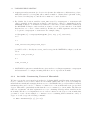
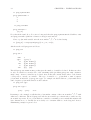
Inequality constraints are declared using the function sosineq, whose basic syntax is similar to
soseq. For example, type
>> Program1 = sosineq(Program1,diff(p,x)-x^2);
to add the inequality constraint1
∂p
− x2 ≥ 0.
∂x
(3.6)
However, several differences do exist. In particular, a third argument can be given to sosineq to
handle the following cases:
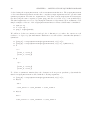
• When there is only one independent variable in the SOSP (i.e., if the polynomials are univariate), a third argument can be given to specify the range of independent variable for which
1
We remind you that
in Section 1.1.
∂p
∂x
− x2 ≥ 0 has to be interpreted as
∂p
∂x
− x2 being a sum of squares. See the discussion