1
'1
PAGE:
4
...
A CHEAP PRINTER
R. N. Thornton
1403 Mormac Road
Richmond, Va. 23229
•
I recently decided to add a printer to my micro, a home-brew ELF based on
the Popular Electronics articles. Naturally, I wanted manuscript quality, quiet
operation, low power, variable paper width up to 14 inches, tractor and/or pinch
feed, high reliability, etc., etc. After writing to a number of suppliers, I
found that such a printer would cost roughly 20 times my total computer investment to date. Even a used Selectric typewriter was $350 without interface.
Finally, I saw an advertisement in ON-LINE (now the Computer Shopper) for a 32
character per line printer for $95. This represented quite a compromise relative
to my original desires, but was affordable. After further consideration, I
realized the printer would be a perfect companion for a 32 character per line
video display. I ordered the printer from:
Carl Poulson
1601 Roder Ct.
Streamwood, Illinois 60103
sending my money order for $95.00 (U.S.). The printer arrived in about 3 weeks
via U.P.S. It was well packed, and weighed about 45 pounds. The printer is a
used, reconditioned model made by Bunker Ramo, and contains a dot matrix print
mechanism made by the Victor Comptometer Company. The cabinet is about 18"x16"x6~",
and contains the power supply, printer mechanism, and electronics for the ASCII
interface. The cabinet top lifts for e~s, maintenance access, and all parts are
fastened with twist lock screws for fast removal. The printer mechanism is a 5x7
dot matrix mechanism which prints 80 characters per second in 32 columns on 3.5
inch wide adding machine paper. A complete set of schematics and adjustment
procedures is supplied with the printer.
•
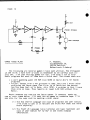
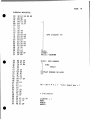
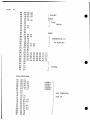
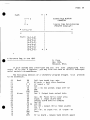
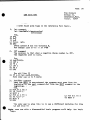
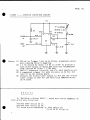
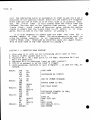
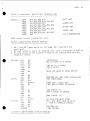
The ASCII interface uses 7-Bit ASCII in parallel. To use the printer, the
buffer must be loaded with 32 characters, one at a time, and then a print command
is issued.
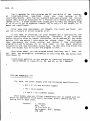
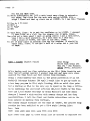
To load a character into the buffer, the character is presented in parallel
on the data lines, and the print command line is brought high. The computer must
then wait until the printer busy line goes high and back to low before loading
the next character. After all 32 characters are loaded into the buffer, an ASCII
carriage return (hex 0n) is placed on the data lines, and the print command line
is brought high. Loading for the next line may begin after the print busy line
goes high and then low. Since the print mechanism works right to left, if fewer
than 32 characters are loaded, they will be right justified on the line. The
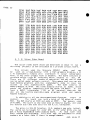
print character set includes 0-9, A-Z (upper case only), blank, and 19 special
characters. A 2516 ROM is used to generate the print characters. I believe a
2708 EPROM could be used to change/expand the character set, though I haven't tried
this yet.
•