1
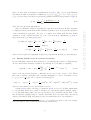
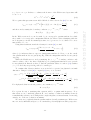
We can resolve this apparent conflict by interpreting log Z(∆)T as only giving the
temperature-dependent behavior of the partition function. Since the temperature dependence here is a global identification, T will not show up in the local curvature expansion
of the heat kernel. If we wish to compute the full partition function on thermal AdS2 , and
verify that Pol(∆) is in fact a polynomial, then we need to include both contributions.
4.2
Partition function on thermal AdS via heat kernel on quotient of hyperbolic space
k=0
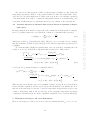
which agrees with eq. (4.6) without Pol(∆). Therefore, we see in this concrete example
that the normal mode method as used in [1] provides only the temperature dependent piece
log Z(∆)T .
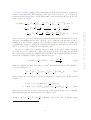
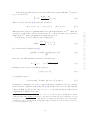
To obtain the full log Z(∆) via a quasinormal or zero mode method, including the local
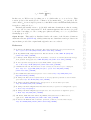
behavior, we need to include the temperature-independent piece. This term is
Z ∞ Z
Vol(H2 /Z)
dt
√
d2 x gK H2 (t, x, x) =
log Z H2 (∆)
t H2 /Z
Volreg (H2 )
0
1
1
Vol(H2 /Z)
[−1 + log (LΛRG )] ∆(∆ − 1) + log (LΛRG ) −
=
Volreg (H2 )
3
4
+2ζ ′ (−1, ∆) − (2∆ − 1)ζ ′ (0, ∆) .
(4.8)
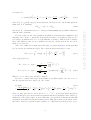
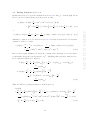
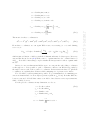
So the full 1-loop partition function on thermal AdS2 is:
h
i
X
k+∆
log 1 − e− LT
log Z H2 /Z (∆) = −2
k=0
+
Vol(H2 /Z)
Volreg (H2 )
1
1
[−1 + log (LΛRG )] ∆(∆ − 1) + log (LΛRG ) −
3
4
+2ζ ′ (−1, ∆) − (2∆ − 1)ζ ′ (0, ∆) .
(4.9)
This expression now has the expected logarithmic behavior at large ∆ as seen in the heat
kernel curvature expansion, and as expected from the anomaly in even dimensions. Note
that the new term in the second line of (4.9) is temperature independent (except for the
volume contribution); thus it did not show up in the explicitly temperature-dependent
contribution calculated in [2], nor in the equivalent calculation done for general AdS in [1].
5
Extension of story to all even dimensions
We now extend the procedures of section 2 to all even dimensional AdSd+1 for d + 1 = 2n.
– 14 –
JHEP06(2014)099
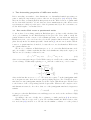
From [2], using the heat kernel on a quotient of H2 constructed from the method of images,
the 1-loop partition function for a scalar field of mass m on thermal AdS2 is given by
h
i
X
− k+∆
LT
log Z(∆)T = −2
log 1 − e
(4.7)