1
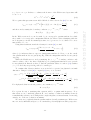
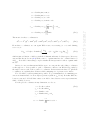
qlλ
d
d+1
d
2 η
; − sinh
.
= (i sinh η) F iλ + + l, −iλ + + l; l +
2
2
2
2
l
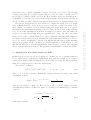
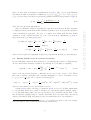
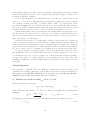
Using the quadratic transformation 15.3.30 in [26], we rewrite q (now dropping the Y ) as
l+∆ l+d−∆
d+1
l
2
ql∆ ∝ (i sinh η) F
,
;l +
; − sinh η .
(A.5)
2
2
2
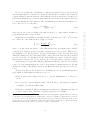
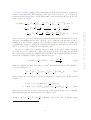
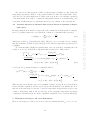
As long as ∆ − d/2 is not an integer, we can use 15.3.7 in [26] to expand q near η → ∞:
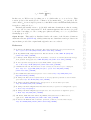
d+1
Γ d2 − ∆
l+∆ 1+∆−d−l
d
−2
−∆ Γ l + 2
F
,
; 1+∆− ; − sinh η (A.6)
ql∆ ∼ (sinh η)
2
2
2
Γ l+d+1−∆
Γ l+d−∆
2
2
d+1
d
Γ l+ 2 Γ ∆− 2
l+d−∆ 1−l−∆
d
−2
+ (sinh η)∆−d
F
,
;
1−∆+
;
−
sinh
η
.
l+1+∆
2
2
2
Γ l+∆
Γ
2
2
These modes already satisfy the condition of regularity in the interior of Hd+1 ; this is how
we chose to consider the solution (A.3) to the second-order differential equation in (A.2).
In order to satisfy the η → ∞ boundary condition in (A.2), we must choose ∆ such that
the second line in (A.6) vanishes. This occurs whenever one of the Γ functions in the
denominator has a pole; that is, whenever l + ∆ ∈ Z≤0 . Since l is already restricted to be
a nonnegative integer as it labels the total angular momentum of the spherical harmonic
Yl m
~ in (A.3), this forces ∆ to be a negative integer.
For d + 1 even, ∆ − d/2 is not an integer, and our analysis is complete; there is a zero
mode for ∆⋆ ∈ Z≤0 with degeneracy equal to the sphere degeneracy for a mode on S d+1
with total angular momentum −∆⋆ .
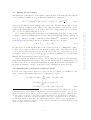
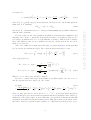
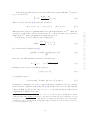
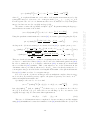
Specifying to the case d + 1 = 2, we find
h
η i
,
(A.7)
φ∆l = eilθ (i sinh η)|l| F ∆ + |l|, |l| + 1 − ∆; |l| + 1; − sinh2
2
has only (sinh η)−∆ (and no (sinh η)1−∆ ) behavior at η → ∞ whenever ∆ = ∆⋆ for
∆⋆ + |l| ∈ Z and ∆⋆ + |l| ≤ 0. Since here we are allowing l ∈ Z to account for both
exp(ilθ) and exp(−ilθ), we can rewrite this requirement as
∆ ∈ Z≤0 ,
l ∈ Z,
|l| ≤ −∆.
(A.8)
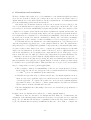
The case of odd dimensions is more complicated. d is an even integer, and the analysis
using (A.6) is insufficient because the formula 15.3.7 in [26] is invalid when ∆ − d/2 ∈ Z. In
– 20 –
JHEP06(2014)099
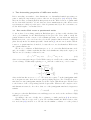
d
where Yl,m
~ is a spherical harmonic on S whose total angular momentum is set by the
nonnegative integer l. m
~ is a set of d − 1 integers with l ≥ md−1 ≥ . . . ≥ |m1 |, m1 ∈ Z.
For the specific case of d + 1 = 2 dimensions, there is no m;
~ instead for every nonnegative
integer l we have two modes: exp (ilθ) and exp (−ilθ).
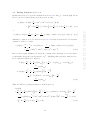
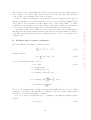
We want to rewrite the eigenvalue as ∆(∆ − d)/L2 . Reparameterizing the hypergeometric function in terms of ∆, we find
d + 1 1 − cosh η
l
φl∆ ∝ Yl,m
;
.
(A.4)
~ (i sinh η) F l + ∆, l + d − ∆; l +
2
2