1
Manual revision 017
Appendix VI: Wave Theory and Statistics
SBE 26
The influence of the Hanning window is removed with a deconvolution in the
time domain; each point xi is multiplied by the inverse of the Hanning window
wi corresponding to the same time point. This procedure is unstable near the
end points where wi ≈ 0. Therefore, the time series is set to 0 at the beginning
and end where the window reaches 1% of its maximum value.
Finally, each point in the time series is multiplied by 1 / sqrt (8/3) to
compensate for the initial scaling of the time series.
Total Variance and Energy
The unbiased sample variance is a fundamental statistical measure of the time
series. Variances from different bursts can be compared to see if the wave field
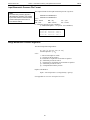
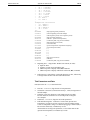
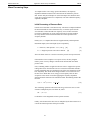
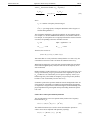
is stationary or changing. The unbiased estimator for the variance is:
N-1
2
< σx > = (1 / [N-1])
∑ |xj
j=0
- < μ x> | 2
[m2]
[30]
where μx is the sample mean. In this case, the mean is zero since the time
series has been de-meaned. The variance obtained from the reconstructed time
series can be compared with the total variance obtained from the autospectrum [25] as a check on the goodness of the time series reconstruction.
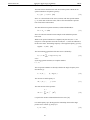
An estimate of the total wave energy contained in the record is:
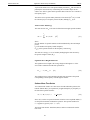
E = W w < σx 2>
[J / m2]
[31]
Average Wave Height and Period: Havg, Tavg
Since the wave time series is typically very irregular due to the random nature
of the sea surface, the calculation of wave heights and periods can only be
approximate and statistical. A standard method for estimating wave heights
and wave periods is summarized in the Handbook on Wave Analysis and
Forecasting, from the World Meteorological Organization (WMO- No. 446,
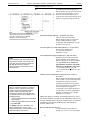
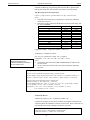
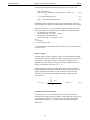
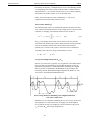
1976, Geneva, Switzerland) and illustrated below:
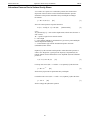
Zero-Crossing Method for Estimating Wave Heights and Periods
from a Wave Time Series
Individual waves are isolated by identifying the zero upcrossings; H and T for
each captured wave is stored in an array. Averaging over all the captured
waves yields the average wave height Havg (meters) and the average period
Tavg (seconds). Hmax is the largest captured wave.
96