1
and IP-solvers support integer domains. Hence, tools can be
implemented at a higher level of abstraction. For example, it is
possible to take advantage of the bidirectionality of clauses and
simulate logic gates in both directions. In contrast to pure Prolog, no backtracking is required for forward simulation. Furthermore, several problems can be handled concurrently by
specifying the subproblems with constraints and solve them in
one step instead of solving subproblems sequentially.CLP languages have been used for test generation [24] for the gate
level. Our work is the first one using CLP languages at the register transfer level.
It turns out that the techniques we propose can also be applied
for retargetable code generation for general programming languages [11, 12, 18, 21, 22, 28]. In fact, our techniques are capable of compiling a restricted set of programs into machine
code.
3. RESTART: OVERVIEW
The retargetable compiler RESTART (REtargetable Self-Test
progrAm geneRaTion), automatically compiles a user specified self-test program onto the given target processor. The
result is an executable micro- or machine code and a set of
external stimuli. Generated programs are intended to be used as
internal off line tests e.g. after a processor restarts. RESTART
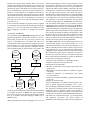
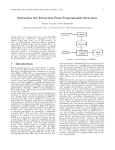
(Fig. 1) contains two inputs (processor description, test program specification) and two outputs (binary code, stimuli). We
HDL
TCL
hardware
description
test code
specification
language
front-end
front-end
circuit analysis
retargetable self-test code generator
binary
code
Fig. 1
self-test
program
stimuli
primary
input
pattern
use the description of the target architecture (hardware) and the
test program (software) as inputs. The target architecture
(processor) is expected to be described at the register transfer
level by a hardware description language (VHDL [14] or
MIMOLA [20]).
TCL (Test program speCification Language) serves as a com-
fortable input language to specify self-test programs. A selftest program is specified by a test engineer, well acquainted
with the RT structure of the processor. It is expected that a test
engineer runs ATPG tools for each RT component to be tested,
resulting in a set of test patterns for each RT component. Therefore, the fault coverage depends on the ATPG tool and the
internal structure of the RT component to be tested. RESTART
will achieve 100% fault coverage if the test patterns provided
by the ATPG tool covers 100% of the component faults and if
code generation is successful for all patterns. The test patterns
are made available using TCL and RESTART generates binary
code and stimuli which applies every test pattern to the RT
components and checks the response. In this way, RESTART is
a hierarchical test generation tool and RESTART based on
single fault assumption, is independent of a special fault model.
With our approach the obtained fault coverage depends on the
TCL program. The human test engineer is responsible for: fault
model, test strategy, fault coverage and test length. If specific
hardware features for increasing the testability (e.g. a scan
path) is available in the processor and described within the RT
structure, this hardware can be used by RESTART.
The result of RESTART is an executable program and a set of
external stimuli patterns. The program consists of a set of
instructions. Each instruction is a pair (Label, BitString), i.e. an
address within the instruction memory address range and a bit
string consisting of 0, 1, X. A stimuli pattern is a triple (PrimaryInputName, Time, BitString). The time at which the bit string
must stimulate the primary input is computed with respect to
the clock cycle time of the processor. To validate the generated
binary code an integrated simulator [6, 4] is able to simulate the
circuit together with program and stimuli.
A summary of the main features of RESTART includes:
a)Optional compaction of the generated code.
b)Generation of external stimuli.
c)Provides a comfortable self-test program specification language (TCL).
d)Declaration of an arbitrary number of variables in a register
component.
e)Concurrent application of transformation rules during
resource allocation.
f) Concurrent and global scheduling, compaction and binding
of the code.
g)Support for residual control.
The task of RESTART is to compile self-test programs. Compared to general programming languages, TCL is just a
restricted language. RESTART exploits the special features of
TCL programs to efficiently generate code for a wide range of
architectures. Self-test programs contain a large amount of
conditional jumps, comparison operations and constants (the
test patterns) to be allocated. Therefore RESTART has knowledge about a set of transformation rules, e.g. for IF statements
and comparison expressions. The special features of
RESTART which are helpful to compile self-test programs are: