1
Chapter 6 – Input and Output Functions
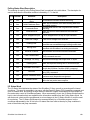
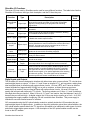
One of the most important features of SilverMax is the input/output capability. SilverMax has seven multipurpose I/O lines. These seven lines can be independently software configured for a variety of functions.
This chapter covers the basic operation of all SilverMax I/O lines as well as their different uses. There are
four kinds of SilverMax I/O functions:
•
Digital Inputs. All seven of the I/O lines can be used as digital inputs, allowing SilverMax to react
to on/off inputs like a PLC.
•
Digital Outputs. All seven of the I/O lines can also be configured for use as digital outputs,
allowing SilverMax to send on/off signals and control simple systems.
•
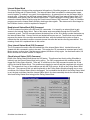
Analog Inputs. I/O lines 4, 5, 6, and 7 can be configured as 0 to +5 V analog inputs, allowing
SilverMax to use analog signals for direct motion control or as analog sensor inputs.
•
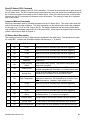
High-Speed I/O Functions. SilverMax can use its I/O lines for two special high-speed I/O
functions: scalable internal encoder output and scalable step and direction input. These I/O
functions are used in several SilverMax applications, including electronic gearing and camming
operations. For normal uses, the fastest sampling rate for a SilverMax I/O line is once every servo
cycle (every 120 usec). For high-speed functions, however, the maximum sampling rate is about 1
MHz, or once every 1 usec.
These functions can be used in many different types of applications. This chapter covers each I/O
function‘s operation, the commands used with each function, and the different uses for each function in a
SilverMax application.
Input and Output Operation
SilverMax has seven fully programmable I/O lines. Each line can be used as a digital output or a digital
input, while some of the lines can be used as analog inputs or configured for special uses. Each I/O line
can be configured dynamically, either by a SilverMax program or by an external host. This section covers
the functions that the I/O lines can be used for, the operation of the I/O lines, and the conflicts that can
occur between different I/O functions.
SilverMax I/O Lines
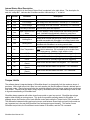
The I/O lines on SilverMax are TTL level. TTL signals are 0 or +5 V and are not capable of driving much
current. QCI offers an optical isolation module designed to work with the SilverMax I/O lines that provide
input and output optical isolation and can handle larger currents. I/O lines 1 through 7 can be used as
digital inputs or digital outputs. I/O lines 4 through 7 can be used as digital inputs or outputs, but can also
be used as analog inputs. When used as analog inputs, they must receive a 0 to +5 V signal. An
understanding of the electrical characteristics and requirements of the seven I/O lines is essential to
properly using the SilverMax I/O.
SilverMax User Manual 4.0
105