1
Dry or Low Moisture Food/Animal Feed Samples
Dry food/animal feed samples may not need a
drying step, but usually require some pretreatment.
Samples such as cereals and grains should be ground
and dispersed before extraction. A mortar and pestle
sufficient for many samples are excellent tools for this
purpose. Other samples may require more extensive
grinding to increase the surface area for optimum solvent
penetration. For example, some animal feed samples
may need to be ground into a course powder for optimal
analyte recovery. Usually particles in the range of 1–2
mm (about 10–20 mesh) are sufficiently small.
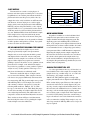
Dionex has studied the effects of sample surface
area on extraction efficiency. Three samples of mozzarella cheese were prepared differently and extracted for
fat content using ASE. The ground samples were ground
with ASE Prep DE (1:2). Each sample was extracted
with a mixture of hexane:2-propanol (3:2) using the
following ASE conditions: 1000 psi, 125 °C, 6 min
heat-up, 3 x 10 min static cycle, 100% flush, 60 s purge,
11-mL cells containing one cellulose filter. The extracts
were analyzed gravimetrically. The ASE results were
compared to results obtained from Mojonnier extraction.
These results are shown in Figure 1 and demonstrate
that increasing the surface area by grinding the sample
results in higher extraction efficiencies.
100
Recent Recovery vs Mojonnier
Plant Material
Plant material can contain a varying degree of
moisture and often requires treatment prior to extraction.
Lyophilization is an excellent pretreatment method for
plant materials because this process yields a fine, dry
sample that can be easily loaded into an ASE extraction
cell. However, if freeze-drying is not a viable option,
simply grind (or mix) the plant material with ASE Prep
DE using a mortar and pestle. Initially, a ratio of plant
material to DE of 1:1 is a good mixture, but the amount
of DE may need to be increased if the plant material is
very wet. Sufficient DE has been mixed with the sample
if the sample can be easily removed from the mortar
without adhering to the sides of the mortar. If the plant
material is low in moisture, it can be ground in a blender
or mill to produce small particles (<2 mm). Cryo-grinders have also been used successfully.
80
60
40
20
0
Whole
Chopped
Hex: IPA, 125 °C, gravimetric analysis
Ground
225690
Figure 1. ASE Sample Preparation Effects vs Mojonnier Extraction.
Mixing and Dispersing
Regardless of whether or not the food/animal feed
sample has been pretreated to remove moisture, most
samples should be mixed with a dispersing agent. The
dispersing agent can be ASE Prep DE, as mentioned
above, or dry samples can be dispersed with sand (20–30
mesh particle size or Ottawa sand if available. Sea sand is
not recommended for use as a dispersing agent and may
cause premature failure of ASE instrument components).
Dispersing the sample prevents sample compaction in
the extraction cell, increases the surface area, and allows
the solvent to better penetrate the sample matrix. As a
result, extraction efficiency and precision improve. For
dry samples, this pretreatment step should take just a few
minutes, but is very important.
Choosing the Correct Cell Size
As a first approximation choose a cell size that is at
least double the mass of the sample. For example, if the
sample size is 10 g, consider using a 22- or 33-mL cell.
If extracting a 30-g sample consider a 66- or
100-mL cell. This guideline applies to samples that
require pretreatment such as dispersion with ASE Prep
DE or another drying agent. However, if the sample for
extraction is in the form of a finely dispersed, dry powder, 10 g of such a sample will most likely fit into an 11mL extraction cell. Additional factors to consider when
choosing a cell size include sample swelling and the
ratio of drying agent to sample used. If the sample tends
to swell excessively during extraction, consider using a
larger cell and leave some void volume in the extraction
cell to accommodate swelling. If the sample is very wet
and a large amount of ASE Prep DE is used, a larger cell
may be required.
Accelerated Solvent Extraction (ASE) Sample Preparation Techniques for Food and Animal Feed Samples