1
FastFix Platform User Manual
usage environment). Its main purposes are (a) to collect context information monitored
by sensors, (b) to perform data pre-processing tasks before sending information to the
maintenance site (for security and performance), (c) to access supervisor mechanisms in
the target application (for self-healing), and (d) to provide a user interface to allow users
to regulate the FastFix functionality (e.g. start and stop sensors).
The client namespaces currently contains 100 classes with 504 methods in 37 packages
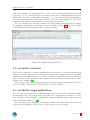
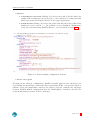
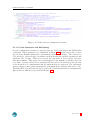
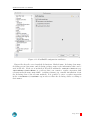
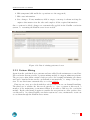
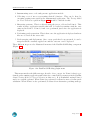
(10 bundles), with a total of 4,632 lines of code in 110 files. Figure 2.2 shows a screenshot
of the FastFix client UI including three registered sensors.
Figure 2.2: FastFix client platform UI.
2.2 eu.fastfix.common
The common namespace contains bundles which are needed by both the FastFix client
and server. In the current state of the system, the FastFix common namespace includes
bundles from nine different areas of concern, including context observation, persistency,
error reporting, fault replication, and communication between client and server. More
details can be found in [11].
The common namespaces currently contains 340 classes with 2,113 methods in 56 packages (12 bundles), with a total of 17,894 lines of code in 343 files.
2.3 eu.fastfix.targetapplication
The targetapplication namespace contains bundles that are supposed to run in the runtime
environment of the target application. Typically such components are sensors (or actuators). Bundles in this namespace communicate with the FastFix client via the interfaces
of the application bridge (cf. [11]).
The targetapplication namespaces currently contains 117 classes with 824 methods in
32 packages (11 bundles), with a total of 9,267 lines of code in 114 files.
Page 8 of 47