1
FX3U/FX3UC Series PLC User's Manual - Positioning Control Edition
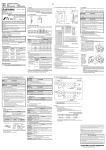
8 1-Speed Positioning - DRVI/DRVA Instruction
Built-in Positioning Function
8.2.3
8.2 Drive to Increment - DRVI Instruction
Function and Operation
This instruction is a 1-speed positioning instruction and uses the relative drive method. For this instruction,
the transfer distance from the current position to the target position should be specified together with a plus or
minus sign. This method is also referred to as the incremental (relative) drive method.
→ For details on "Instruction execution complete" flag, refer to Subsection 4.7.4.
→ For details on the maximum speed, bias speed, acceleration time, and deceleration time, refer to
Section 4.2.
Command
input
FNC 158
DRVI
S2•
S1•
D1•
D2•
Acceleration
time
Deceleration
time
Speed
Maximum speed
Output pulse
frequency S2•
Number of output
pulses S1•
Bias
speed
Time
Instruction execution
"Instruction
execution complete" flag
M8029
ON
1) For S1 , specify the number of output pulses (relative address value).
Setting range
16-bit operation
-32,768 to +32,767
32-bit operation
-999,999 to +999,999
2) For S2 , specify the output pulse frequency.
Setting range
16-bit operation
32-bit operation
10 to 32,767(Hz)
When high-speed output special
adapter is used
10 to 200,000(Hz)
When transistor output of main unit
10 to 100,000(Hz)
is used
3) For D1 , specify the pulse output number in the range of Y000 to Y003.
4) For D2 , specify the rotation direction signal output device number.
When a high-speed output special adapter is used as a destination for pulse output on a FX3U PLC, use
the output shown in the following table for rotation direction signals.
When a built-in transistor output is used as a destination for pulse output on a FX3U/FX3UC PLC, use
transistor output for signals rotation direction.
High-speed output special
adapter connection position
The 1st adapter
The 2nd adapter
B - 104
Pulse output
destination device
Rotation direction
output
D1
= for Y000
D2
= Y004
D1
= for Y001
D2
= Y005
D1
= for Y002
D2
= Y006
D1
= for Y003
D2
= Y007