1
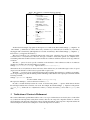
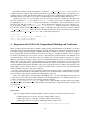
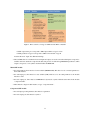
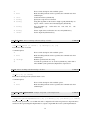
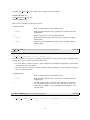
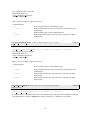
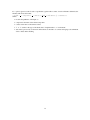
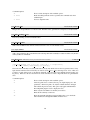
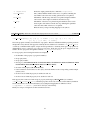
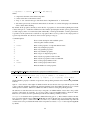
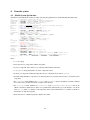
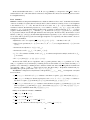
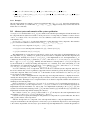
Table 1: The OTHELLO constraints language grammar.
constraint
:=
atom
:=
term
:=
atom |
not constraint |
constraint and constraint |
constraint or constraint |
constraint implies constraint |
always constraint |
never constraint |
in the future constraint |
constraint until constraint;
true |
false |
term relation term |
time until( term ) relation term |
change( port )|
term ;
port |
constant |
term function term |
der( port ) |
next( port ) ;
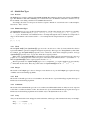
φ
:=
a
:=
t
:=
a|
¬φ |
φ∧φ|
φ∨φ|
φ→φ|
Gφ |
G¬φ |
Fφ |
φ U φ;
>|
⊥|
t ./ t |
B./t t |
v 0 6= v |
t;
v|
c|
t?t|
v̇ |
v0 ;
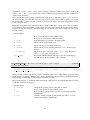
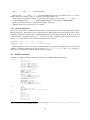
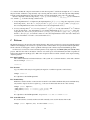
Another classical example of properties is the response to a certain event. The formula always (p implies in
the future q) defines the set of traces where every occurrence of p is followed by an occurrence of q. Note that q
may happen with a certain delay (although there is no bound on such delay). The formula always (p implies q)
instead forces q to happen at the instant of p.
The above formulas do not constrain the time model of the traces. Therefore, they can be interpreted either
as discrete traces or as hybrid traces. However, the logic is suitable to characterize specific sets of hybrid traces,
constraining when there should be discrete events and how the continuous variables should evolve along continuous
evolutions.
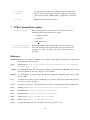
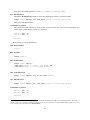
The der(.) operator is used to specify constraints on the derivative of the continuous evolution of continuous
variables. For example, the following OTHELLO constraint:
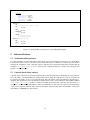
always (train.location<=target implies der(train.location)>=0)
characterizes the set of hybrid traces where in all states, if the train has not yet reached the target location, its speed
(expressed as the derivative of the location) is greater than or equal to zero.
The next(.) operator is used to specify functional properties requiring discrete changes to variables. For example,
we can express the property that the warning variable will change value after the train’s speed passes the limit with the
following constraint:
always (speed>limit implies
in the future next(warning)!=warning)
The expression change(x) can be used instead of next(x)!=x.
In order to constrain the delay between two events, we use the time_until(.) operator, which denotes the time
that will elapse until the next occurrence of an event. For example, the formula always (p implies time_until
(q)<max_delay) defines the set of hybrid traces where p is always followed by q in less than max_delay time
units.
3
Verification of Contracts Refinement
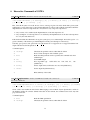
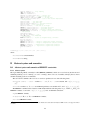
The contract refinements specified in the OSS be seen as a set of proof claims that are resolved by the tool. The claim
say 1) that if the subcomponents satisfy their contracts, then also the composite component satisfies its contracts,
and 2) that if the subcomponents satisfy their contracts and the environment of the composite component satisfies the
related assumptions, then also the assumptions of each subcomponents are satisfied.
9