1
9.5. DEVIANCE, AIC AND RELATED TOPICS (L35-L44 AND L431- L502)
73
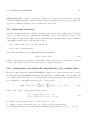
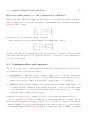
largest eigenvalue). In this case, the advice is to set smaller tolerances and re-run the same model.
Sometimes, it is not enough and the model has some difficulties to achieve convergence, i.e. estimates
are close to the mles but numerical difficulties slow down the convergence. Fixing some parameters
is another possibility and is very efficient: for example fixing the last capture probabilities to one
for the CAS model or fixing to zero capture probabilities at occasion when there is no capture.
9.5
Deviance, AIC and related topics
(L35-L44 and L431- L502)
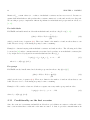
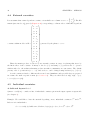
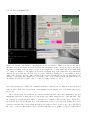
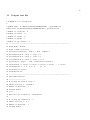
First, the time needed to obtain the parameter estimates and the time needed to calculate the Hessian
are respectively given in L90 and L91, together with the number of iterations(L93). Line 75 and 76 give
the deviance and the Akaike information criterion amended for overdispersion (Qaic):
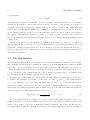
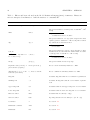
QAIC = dev/ĉ + 2 ∗ rank
L84 gives ĉ (c-hat, provided by the user according to the results of gof tests; default is 1. and L79 gives
an estimate of the rank of the model conditional on the data. By default in e-surge, the rank is the
maximum of numerical rank of derivatives matrix [43]) of the summary statistics calculated at several
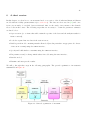
neighbors (µ) of the mles (section 7.2). The algorithm to compute the rank is summarized below:
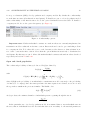
1. Choose a point µ near the mles.
2. Compute Dµ the derivatives matrix at µ.
3. Normalize Dµ by Gµ .
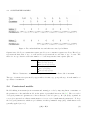
4. Compute U , V orthogonal matrices and E diagonal matrix such that U t Dµ Gµ V = E.
5. Estimate rank(µ) =
P
i (ei
≥ me1 ) where m is the number of columns of Dµ .
The rank can be also estimated less precisely by the numerical rank of the computed Hessian plus the
estimated number of boundary parameters, based on a threshold to decide which eigenvalues listed
in L428 to L499 can be considered as equal to zero, (as mentioned in the previous paragraph). This
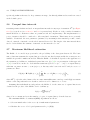
threshold criterion λi ≥ ∗10−7 ∗ λ1 , where n is the size of the Hessian matrix (L78) and λ1 its largest
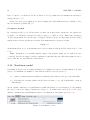
eigenvalue. Thus instead of the current value estimated by the numerical CMF method (section 7.2),
L79 may give the number of eigenvalues which satisfy this criterion plus the estimated number of
boundary parameters (L80). Following [49], another less severe threshold is applied in e-surge as
λi ≥ n ∗ 10−4 ∗ λ1 .
The difference between the results of the application of the two thresholds is given in L82. These
results can be used together with theoretical calculations for advanced investigations of redundancy
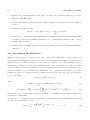
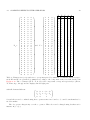
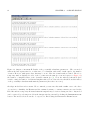
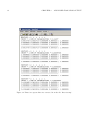
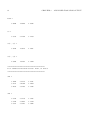
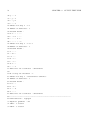
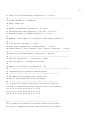
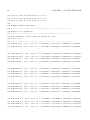
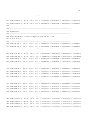
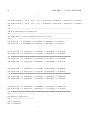
issue. In this example, we see from L428-L499 that the rank is at least 70, as all eigenvalues but two
(-0.00000801 0.00172081) are clearly larger than 0. However, two estimates are considered as being