1
Appendix
DIN 50438, Part 21
Testing Materials for Semiconductor Technology: Determination of Impurity Content in Silicon Using Infrared Absorption - Part 2: Carbon
1. Range of Application and Purpose
The process, according to this standard, is used to determine the carbon content
of silicon. The absorption coefficient of substitutional carbon at a wave number
of 605 cm-1 (16.5µm - absorption band) is used to measure carbon content.
Therefore, this procedure does not apply to carbon that may be present in
another form in the silicon lattice or chemically linked or is precipitated at gain
boundaries or other places. With this limitation, the application range of the
procedure covers plane-parallel, two-sided polished test pieces of single-crystal
or polycrystalline silicon with charge carrier concentrations under 5 x 1016cm-3,
regardless of conductivity type and crystal orientation. The measurement range
for the carbon concentration lies between 5 x 1015cm-3 and about 3 x 1018cm-3.
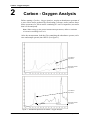
Due to the strong silicon lattice absorption (absorption coefficient KG ≈ 8cm-1
for wave number 605 cm-1 (2)), that is superimposed on the (605cm-1) band
generated by the carbon, the carbon content can only be determined using a differential process.
1.DIN 50438, Part 2 (1982): Testing of Materials for Semiconductor Technology: Determination of Impurity Content in Silicon Using Infrared Absorption - Carbon. Berlin: Beuth Verlag GmbH.
28
OPUS SEMI
Bruker Optik GmbH