1
DIN 50438-1 A (93) Method - Oxygen
Note: The conversion coefficient (0.82 x 1017cm-2) is valid for spectra acquired
at room temperature. But this method can also be used for spectra acquired at
cryogenic temperatures (below 80 K). In this case, the absorption band peak is at
607.5cm-1 and the recommended conversion coefficient is 0.37 x 1017cm-2.
11) The carbon concentration value cC is multiplied by the factor FC (default
value FC=1) which can be specified by the user in the CARBon-OXygen
Analysis dialog window.
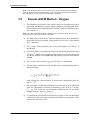
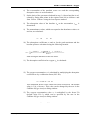
C C = cC • FC
3.9
DIN 50438-1 A (93) Method - Oxygen
1) The thickness of reference wafer and test wafer are determined by either
measuring the thickness using a caliper gauge or by calculating the
thickness using the silicon phonon peak at 610cm-1 in the absorbance
spectra. (See section 3.1.)
2) The absorbance spectrum of the reference wafer is multiplied by the factor d m ⁄ d r (with dm being the thickness of the test wafer and dr being the
thickness of the reference wafer).
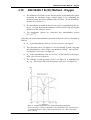
3) The absorbance spectra are converted into transmittance spectra
(Tr = 10-Abs).
4) A so-called comparison spectrum is calculated by dividing the test wafer
spectrum by the reference wafer spectrum.
5) The minimum transmittance value of the oxygen peak at 1107cm-1 is
determined.
6) This data point plus two data points on the right and two data points on
the left (totally 5 data points) are used for a least squares fit to a parabola.
7) The wavenumber of the parabola vertex vmin and the corresponding
transmittance value TM are determined.
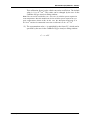
8) On the basis of the spectrum calculated in step 4, a linear baseline is calculated by fitting data points in the regions from 1025 to 1040cm-1 and
from 1180 to 1195cm-1 using the least squares method.
9) The transmittance value of the baseline TB at the wavenumber vmin is
determined.
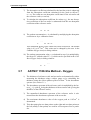
10) The absorption coefficient for oxygen aO is calculated using the following formula:
Bruker Optik GmbH
OPUS/SEMI
17