1
5. MISSION SUMMARY
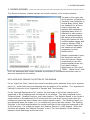
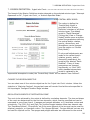
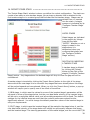
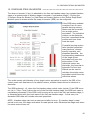
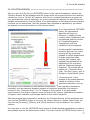
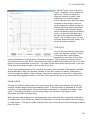
In specifying the density values, you should remember that "average" densities are called
for. These average densities, combined with the masses of propellant, adjunct inert mass,
and primary inert mass, will determine the volumes that, combined with the stage diameter,
will define the heights of the stage's primary inert mass, propellant, and adjunct inert mass
in the rocket drawing.
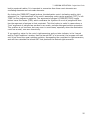
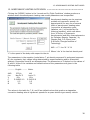
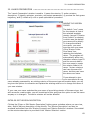
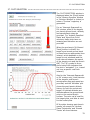
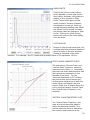
'Maximum Vacuum Thrust' is one of three names that may be displayed in the stage
summary display. The other two alternatives are 'Constant Vacuum Thrust' and 'Average
Vacuum Thrust'. "Maximum" indicates that an optional normalized time-varying thrust profile
was NOT chosen for the stage, but that the stage was allowed to throttle in finite steps.
"Constant" would likewise indicate that a normalized time-varying profile was NOT chosen,
but it would also indicate that the stage was NOT allowed to throttle. "Average" would
indicate that a normalized time-varying thrust profile WAS chosen. Throttling of a timevarying profile is not allowed. If a limit constraint was placed on the vacuum thrust, but the
quasi-optimum solution's value was less than the limit, the designation "Below Limit" will be
displayed. If the solution's value equals the limit, the designation "On Limit" will be displayed.
If an exact value was specified for the vacuum thrust, the designation "FIXED" will be
displayed. If no constraint was placed on the vacuum thrust, the designation "free" will be
displayed.
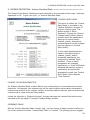
'Diameter of Nozzle Exit' is the diameter of the rocket nozzle's exit plane. The exit-plane
area, calculated from this diameter, is multiplied by the local atmospheric pressure, and the
result is subtracted from the rocket's vacuum thrust to obtain the net thrust.
'Core T/W Ratio at Ignition' is equal to the tandem stage's net thrust divided by the mass of
the tandem-stage stack at the start of the stage (i.e., at rocket-motor ignition). The stage's
achieved T/W will be less than the displayed core value if there is an attached strap-on
booster. The tandem stage's net thrust includes the reduction due to atmospheric pressure
on the rocket nozzle's exit-plane area.
'Core T/W Ratio at Burnout' is defined like its ignition counterpart but at the instant the
tandem stage's thrust becomes zero (i.e., rocket motor burnout).
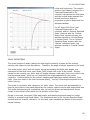
'Time of Ignition' is the time of the tandem-stage rocket motor's thrust initiation with respect
to launch time (t =0.). This time of ignition defines the start of the stage. For the first stage,
it is the launch time (t =0.). For an upper stage, it coincides with the end of the previous
stage.
'Rocket Mass at Ignition' is the total mass of the rocket at the time of ignition, including any
attached strap-on booster.
'Burn Time' is the total burn time of the stage's rocket motor. The time of rocket motor
burnout is equal to the time of ignition plus the burn time.
'Post-Thrust Coast Time' is the time between rocket motor burnout and the end of the stage.
During this time, there is no thrust. At the end of the coast, the stage (inert mass) is
discarded.
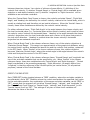
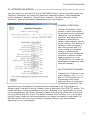
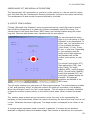
There are five options for a stage's steering method: 'bi-linear tangent', 'inertial hold',
'ballistic', 'retro ballistic', and 'fixed yaw and pitch'. These five steering methods are
explained in the 'Configure Tandem Stage' section.
19