1
1. INTRODUCTION
1. INTRODUCTION ========================================
ZOOM is a computer program for the conceptual design and analysis of rockets and their
missions in the vicinity of a single "central body" such as the earth. The program incorporates
insights and methods that were employed during America's developments of the Saturn V
moon rocket and the Space Shuttle.
It is important to note that, in some places in this manual, the term "earth" is used where it
would have been more appropriate to use the term "central body". You have the flexibility to
modify the default gravitational, dimensional, atmospheric, and rotational parameters and so
define a central body other than the earth.
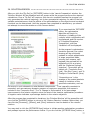
ZOOM can be operated via its graphical user interface (GUI) with a touch-screen interface as
well as with a mouse/keyboard interface. The program has been checked out with Windows
XP, Windows 7, and Windows 8.1 operating systems. However, with Windows 8.1 a "program
has stopped working" error sometimes occurs, apparently at random times.
As far as is known, the Windows 8.1-related error has never been encountered on computers
with Windows XP or Windows 7 operating systems. And, constructive results can often be
obtained on a computer with the Windows 8.1 operating system before the "stopped working"
error is encountered.
ZOOM's optimization procedure was created in the early 1970's and enhanced over a
subsequent period of 35 years. The procedure uses the Simplex algorithm1 in a novel and
powerful way that has found quasi-optimum solutions for a wide variety of trajectoryoptimization problems.
The modeled rocket's tandem stages are defined by core ideal delta-velocities, propellant
mass fractions, and core thrust-to-weight-ratios. From these quantities, ZOOM calculates the
propellant loads, inert masses, and thrusts. The rocket is treated as a point-mass with three
degrees of freedom.
The rocket is symmetric with respect to its "pitch" plane. The rocket rolls automatically to
keep its pitch plane in the plane defined by the rocket's relative velocity and longitudinal axis.
The rocket thrusts along its longitudinal axis, so both the thrust and aerodynamic forces
remain in the rocket's pitch plane for the duration of the flight.
You can opt to specify the thrusts and/or propellant loads of one or more of the rocket's
tandem stages, or you can set maximum limits on the quantities. The program treats these
specifications as constraint equations or inequalities and satisfies them during its iterative
optimization procedure.
The thrust and/or burn time of a strap-on booster can be fixed or optimized within maximum
limits. If the thrust and burn time are both optimized, they can be optimized independently
(within the specified limits), or their optimization can be constrained to keep the strap-on
booster's propellant at a specified value.
1
The Simplex algorithm was created by George B. Dantzig, Ph.D. in the 1930's to solve linear
programming problems and has proven to be unusually robust and effective in this application.
1






![[en] - User manual, [de] - Betriebshandbuch, [fr]](http://vs1.manualzilla.com/store/data/005845053_1-6d1995608e49c7f1600fcad0c20a630a-150x150.png)