1
3. Instrumentation
3.1 Ultra Wideband
Ultra wide band (UWB) is a wireless communication device that uses a wide
spectrum of frequencies as apposed to a narrow band frequency. For example, a similar
wireless device called Bluetooth transmits only at a frequency of 2.4 GHz ± 1MHz.
UWB has the capability to transmit at extremely high rates. The current stage of the
technology allows a maximum transmit speed of about 500Mbps of raw data. Most other
wireless communication devices don’t even come close to the rate of transmission that
UWB does.
3.1.1 Pulse Modulation
To understand why UWB is significantly better in both previously stated
parameters, an examination of the modulation scheme must first be presented. Most
people are familiar with the common modulations schemes referred to as AM and FM.
These are the schemes allocated by the FCC specifically for radio transmissions. AM
uses amplitude modulation and FM uses frequency modulation. Both schemes are very
effective, but come with a specific frequency parameter. Both AM and FM require
signals to be transmitted at very specific
frequencies, called narrow band
frequencies.
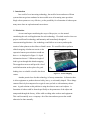
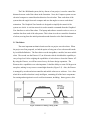
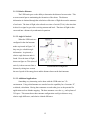
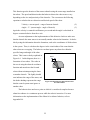
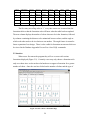
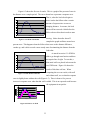
UWB uses a slightly different
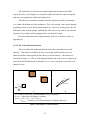
modulation scheme, called Pulse
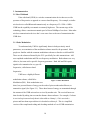
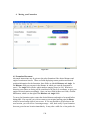
Figure 3-1 Pulse Modulation
Modulation (PM). Pulse modulation uses
short, low powered bursts of energy, on the order of picoseconds and milliwatts, to
transmit its signal (See Figure 3-1). These short bursts of energy are transmitted through
the antenna of the UWB unit and are received by another unit. The received bursts are
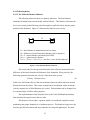
then decoded by taking into account the distance between bursts. For example, if a burst
is received a picosecond early then it is decoded as a binary 1; if it is received a
picosecond later than expected then it is decoded as a binary 0. This is a simplified
version of the complicated coding and decoding methods of a real UWB transmission.
10