1
CHAPTER 4. BASIC STATISTICS EXAMPLES
39 of 132
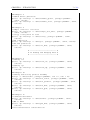
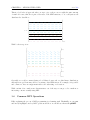
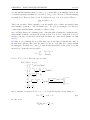
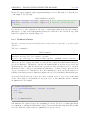
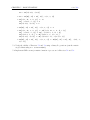
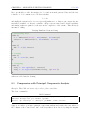
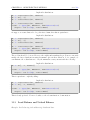
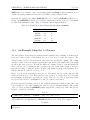
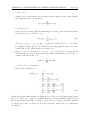
x . min <- allreduce ( min ( x . gbd ) , op = " min " )
8
9
f . quantile <- function (x , prob = 0.5) {
allreduce ( sum ( x . gbd <= x ) , op = " sum " ) / N - prob
}
10
11
12
13
14
15
uniroot ( f . quantile , c ( x . min , x . max ) , prob = prob [1]) $ root
} # End of mpi . quantile () .
✝
✆
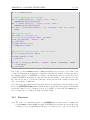
Here, a numerical function is solved by using uniroot() to find out the appropriate value where
the cumulative probability is less than or equal to the specified quantile. Specifically, it finds the
zero, or root, of the monotone f.quantile() function. This simple example shows that with
just a little effort, direct MPI methods are greatly applicable on large scale data analysis and
likelihood computing.
Note that in the way that the uniroot() call is used above, we are legitimately operating in
parallel and on distributed data. Other optimization functions such as optim() and nlm() can
be utilized in the same way.
4.5
Ordinary Least Squares
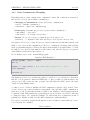
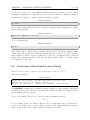
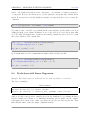
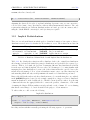
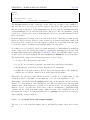
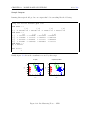
Example: Compute ordinary least square solutions for GBD distributed data.
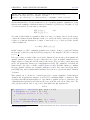
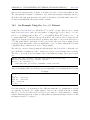
The demo command is
✞
# ## At the shell prompt , run the demo with 4 processors by
# ## ( Use Rscript . exe for windows system )
mpiexec - np 4 Rscript -e " demo ( ols , ’ pbdDEMO ’ , ask =F , echo = F ) "
✝
☎
✆
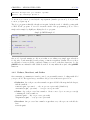
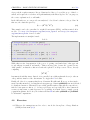
Ordinary least squares (OLS) is perhaps the fundamental tool of the statistician. The goal is to
find a solution β such that
||Xβ − y||22
(4.6)
is minimized. In statistics, we tend to prefer to think of the problem as being of the form
y = Xβ + ǫ
(4.7)
where y is N × 1 observed vector, X is N × p (possibly designed) matrix which is often assumed
to have full rank (more on that later), and N >> p, β is the unknown parameter to be estimated,
and ǫ is errors and to be minimized in norm.
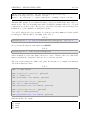
Note that above, we do indeed mean (in fact, stress) a solution to the linear least squares
problem. For many applications a statistician will face, expression (4.6) will actually have a
unique solution. But this is not always the case, and trouble often arises when the model matrix
is rank-deficient. Indeed, in this case it may occur that there is an infinite family of solutions. So
typically we go further and demand that a solution β be such that ||β||2 is at least as small as the
corresponding norm of any other solution (although even this may not guarantee uniqueness).