1
13.
Variables, arrays, and named constants
SB68k requires you to declare the names of all variables used in your program. You declare
variables with the DECLARE statement. For example,
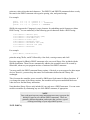
declare
foo
creates the SB68k variable FOO.
Variable names must begin with an alphabetic character or an underscore ('_'); remaining characters
in a variable name can also include digits.
NOTE
Though legal, starting variable names with an underscore can cause
obscure problems if you embed assembly language in your SB68k
source file. See the section below on the ASM statement and
ENDASM statement, regarding references to SB68k variables from
within an ASM block.
All variables use four bytes of RAM (32 bits). The first variable defined is always located at
assembler address VARBEG. Variables are assigned addresses based on the order of their
declarations.
You must declare a variable before your code can reference that variable. This means that you will
usually place all DECLARE statements in a block at the beginning of your SB68k source file.
Note that, unlike traditional Basics, SB68k does not automatically initialize all variables to zero.
The value of any variable following system reset is unknown! Your SB68k program must provide
any needed variable initialization.
SB68k also supports single-dimension arrays, or vectors. Each element in a vector array occupies
one 32-bit location (four bytes). You use the DECLARE statement to define a vector array in much
the same way you use it to define a simple variable. For example:
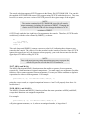
declare
foo(5)
defines the vector array FOO, consisting of five sequential 32-bit locations. The first element in
any vector array is always element zero. Thus, FOO in the above example consists of the five
elements named FOO(0) through FOO(4).
SB68k also supports double-dimension arrays. Each element in a 2D array occupies one 32-bit
location (four bytes). You use the DECLARE statement to define a 2D array in much the same way
you use it to define a vector array. For example:
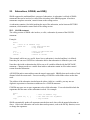
declare
foo(5,4)
21