1
User Manual
M57x/EN M/E
M57x
5.7.6.2
Page 57
Permanent IRIG-B Source Connection
Having a permanently connected IRIG-B source provides the most accurate M57x clock. In
addition to correcting the frequency for the crystal error, the M57x will constantly receive
corrections to compensate for any drift that may still occur. This provides for a typical clock
error of less than 10 microseconds.
5.7.7
Stages of IRIG-B Synchronization and Accuracy
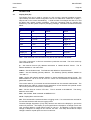
There are four basic stages of synchronization with an IRIG-B source: power-up, time lock,
frequency lock, and final lock.
5.7.7.1
Power-Up Stage
Upon Power-up, the M57x obtains the time from its non-volatile battery backed-up CMOS
clock. This clocks resolution is limited to seconds. Therefore, even if the clock was error
free when it was turned off, the M57x could have an error of up to one second when it is
powered-up.
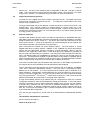
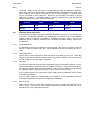
As mentioned previously, the typical crystal error rate is about 50
microseconds per second (50ppm). Therefore, if we assume that the M57x clock was
keeping perfect time before it was reset (or powered down), it would typically be in error by:
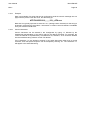
(50 microseconds) x (number of seconds off) + 0.5 seconds after power is restored.
The M57x would start with this error and continue to drift by the frequency offset error. If the
M57x were never connected to an IRIG-B source (or other clock synchronizing source), the
drift would be equal to the crystal’s frequency error. If the M57x previously stored a
frequency correction constant in non-volatile memory, the device will include the
compensation and drift by a smaller amount equal to the true crystal frequency error minus
the correction constant.
5.7.7.2
Time Lock Stage
Once the M57x begins to receive IRIG-B frames, validates a sample buffer, and calculates a
clock correction value, it will enter the Time Lock Stage of synchronization. If the clock
correction value exceeds 120 seconds, the clock is jammed with the present IRIG-B time.
Otherwise, the M57x clock is slewed to match the IRIG-B time.
The accuracy of this initial slew depends on whether a frequency correction constant was
previously stored in non-volatile memory, and if so how accurate the constant is. The M57x
will use this constant in the slew calculation to approximate the rate to change the clock to
adjust to the specified IRIG-B correction error.
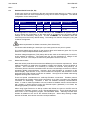
The M57x will remain in the Time Lock Stage for approximately five minutes plus the time
required to perform the initial clock slew. The clock slew requires approximately 30 times the
clock correction value. For example, if the initial clock correction error was 1.5 seconds, the
Time Lock Stage would require approximately 6 minutes (5 minutes plus 45 seconds to
slew).
The M57x enters the Frequency Lock Mode after completing the first IRIG-B clock
correction. The M57x’s clock is typically synchronized to within 1 millisecond of the true
IRIG-B time after the Time Lock Stage is completed.
5.7.7.3
Frequency Lock Stage
The M57x enters the Frequency Lock Stage of synchronization when it receives the third
valid clock correction value from the IRIG-B interface. At this time the M57x calculates a
crystal frequency correction constant based on the clock correction value. The crystal
frequency correction constant is stored in non-volatile memory to provide improved clock
accuracy during ”Free Wheeling.” The crystal frequency correction constant along with the
clock correction value is used to slew the clock to synchronize to the IRIG-B source.
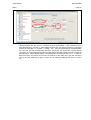
The Frequency Lock Stage requires approximately five minutes. Once the M57x slews its
clock with the correct crystal frequency correction constant, the M57x’s clock is typically
synchronized to within 50 microseconds of the IRIG-B time source. The M57x then enters
the Final Lock Stage of synchronization.