1
150R/150T Quick Start Guide
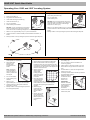
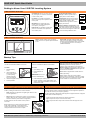
Operating Your 150R and 150T Locating System
Active Location - Direct Connect
Active Location - Induction Clamp
NOTICE: Turn off transmitter when connecting or moving ground stake.
1. Plug cable into transmitter (1).
2. Place clamp around line (2).
1. Drive ground stake (4).
3. Turn on transmitter.
2. Plug cable into transmitter (2).
4. Check battery level.
3. Hook black lead to ground stake (3).
NOTICE: Do not unplug induction clamp from
transmitter when connected to line. Removing
cable will cause an arc and could damage
equipment or cause injury.
4. Hook red lead to line (1).
5. Turn on transmitter.
6. Check battery level indicator.
NOTICE: Do not unplug direct connect cable
when connected to line. Removing cable will
cause an arc and could damage equipment or cause injury.
7. Walk in an arc approximately 25’ (7.5 m) around transmitter.
5. Walk in an arc approximately 25’ (7.5 m) around transmitter.
6. Hold the receiver so that the handle points toward the transmitter, as
shown.
7. Identify location of line by finding the spot with the best signal response.
8. Hold the receiver so that the handle points toward the transmitter, as
shown.
9. Identify location of line by finding the spot with the best signal response.
Active Location - Broadcast
Passive Location
Beacon Location
1. Remove cable, stake, clamp and any other
metal objects from transmitter.
1. Turn on receiver.
1. Install beacon battery with positive end away
from battery cap.
2. Place transmitter
parallel to and
directly above
suspected line as
shown.
Note: Transmitter
must be parallel to
object, as shown, in
order to produce the
best signal.
3. Turn on transmitter.
4. Check battery level
indicator.
5. Walk in an arc
approximately 25’ (7.5 m) around transmitter.
6. Hold the receiver so that points toward the
transmitter, as shown.
7. Identify location of line by finding the spot with
the best signal response.
2. Select frequency and antenna configuration.
3. Make a visual check of the site for signs of
buried lines such as: recent trenching, buried
line markers, overhead lines that run down pole
and underground, gas meters, valve sights, and
drains or manhole covers.
4. Search the site by
walking a grid
pattern while
holding receiver
close to the ground.
Keep the receiver
horizontal.
5. Move the receiver
over the detected
signal to find the
best signal response. If using a peak antenna
mode, rotate the receiver until the signal is
strongest. Strongest signal indicates line
direction.
6. Walk along the
suspected path
while moving the
receiver side to
side.
2. Turn on receiver to ensure that beacon is
functioning properly.
3. Attach beacon to plumber’s snake or flex rod.
4. Place beacon into pipe and move it down the
pipe.
5. To locate beacon, circle over its approximate
location in the pipe.
6. To identify beacon location find the spot with the
strongest signal response.
7. Rotate the receiver
to determine which
direction the
beacon runs.
IMPORTANT:
Receiver indicates
the strongest signal
when handle is
perpendicular to
the beacon.
8. Continue to track the beacon. Mark pipe
location with paint.
7. Sweep, focus, and
trace all detected
signals in the area.
Mark line paths with
colored paint or
flags.
IMPORTANT: See Operator’s Manual for detailed safety and operating instructions.
Laminated: P/N 790-1009 B