1
FH D
Fachhochschule Düsseldorf
University of Applied Sciences
FMDauto
Institut für Produktentwicklung
und Innovation
Harvesting-Combine-Flow Simulation Technique
Page 3/14
There are various ways by which we can mesh the present geometrical entity like:
-
Defining Global parameters which helps in globally controlling the mesh size rather than
changing mesh size parameters for different entities. There are various refinements
techniques for elements in gap. This will result in larger elements on flat planar surfaces
and smaller elements in areas of high curvature or within small gaps. Besides this, we can
define various Shell meshing, Volume meshing parameters and Prism meshing
parameters.
-
Defining Curve Mesh sizes on individual curves or Surface Mesh sizes on individual
surfaces and defining height, minimum size, maximum deviation, tetra size ratio etc.
-
Defining Mesh Density which can be used to define volumetric mesh. This is useful for
refining the mesh in a volumetric zone that isn't adjacent to any geometry
-
Defining Mesh parameters on different parts defined which helps us in having common
mesh parameters for a group of entities.
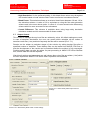
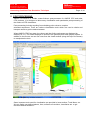
The technique used here in meshing is ‘Meshing by Parts’ because of the convenient fact that
parts are defined accordingly where some geometrical entities can have common meshing
parameters.(Pic 2.3.1) Some important meshing parameters used are:
-
Max Size: The maximum element size multiplied by Global Element Scale Factor.
Height: Height of the first layer of elements on the surface.
Height Ratio: Expansion ratio from the first layer of elements on the surface. This ratio
will be multiplied by the element height of the previous layer to define the next layer.
Number of Layers: Total number of layers above the surface.
After definition of all parameters, volumetric mesh is computed of Tetra/Mixed Mesh type.
After that Prism type mesh is computed using the parameters defined for prism elements in
certain parts where wall effects are to be considered.
Picture 2.3.1: Meshing Parameters by Parts.
2.4
Mesh Editing