1
FH D
Fachhochschule Düsseldorf
University of Applied Sciences
Harvesting-Combine-Flow Simulation Technique
FMDauto
Institut für Produktentwicklung
und Innovation
Page 5/14
3 PHYSICS DEFINITION
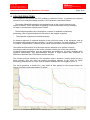
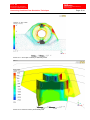
Here meshes which are imported and assembled together as they were meshed differently
and after that basic physical models and settings are applied on the assembly.
This procedure is done in following various steps:
3.1
Importing Mesh
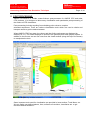
Meshes are imported using ‘Import Mesh’ option and then various mesh transformation tools
are used like translation, rotation, scaling etc. to assemble meshes together.
We can import more than one mesh per ANSYS CFX-Pre simulation. After we have imported
all our meshes and created all our domains, the domains should be joined together, either by
gluing them together, or by using domain interfaces.
3.2
Simulation Type
Here it is decided whether the simulation type is steady (time independent) or transient (time
dependent). Time dependent behavior for transient simulations in ANSYS CFX is specified
through following Transient Scheme:
-
Time Duration: In order to determine when the transient run is to be finished, total
duration of the simulation in real time is mentioned here. It can be set to any one of these
parameters like Total Time, Times per run, Maximum Number of Timesteps, Number of
Timesteps per run etc.
-
Timesteps List: Here we set the actual real time intervals at which the ANSYS CFXSolver solves for the flow field. The timesteps we select are needed to be based on the
time scale of the transient behavior that we want to resolve in our flow simulation.
-
Max. Iterations per Timestep: At each timestep in a transient simulation, the ANSYS
CFX-Solver performs several coefficient iterations or loops, either to a specified maximum
number or to the predefined residual tolerance. The maximum number of iterations per
timestep may not always be reached if the residual target level is achieved first.
-
Transient Scheme: It defines the discretization algorithm for the transient term. There
are two schemes available in transient simulation, which are First Order Backward Euler
and Second Order Backward Euler. The latter scheme is used as default.
3.3
Domains
Domains are regions of space in which the equations of fluid flow or heat transfer are solved.
Here we define the type of region whether fluid, solid or porous. We can select varieties of
fluids and solids available in the Materials list, or we can create a new material by defining its
properties. Various Fluid Models are available for definition like Turbulence Models, Heat
Transfer Models and Combustion Models. Turbulence model used here is Shear Stress
Transport (SST).
For any given CFD problem, more than one domain may be defined. Each time we create or
edit a domain, the physical models (fluid lists, heat transfer models, etc.) are applied across
all domains of the same type (e.g., fluid or solid). Besides this, Domain Motion is also defined.
Each domain can be independently stationary or rotating. For rotating domains, the angular
velocity and axis of rotating are defined for each domain.