1
ECE 477
Digital Systems Senior Design Project
Spring 2006
Memory Mapping
The main program code will be stored in the 512K of Flash memory. Since Flash is non-volatile
and has a limited number of uses, it is the optimal location to store the code file. Program
variables, program stack, and heap will be located on the 512K of SRAM. Also, web pages and
images will be loaded into the SRAM from the serial flash during program execution. This
should be plenty of memory to accommodate everything since the largest portion will be used by
images and web pages which won’t be more than 50 – 100K. User data and the consumption log
consisting of time, date, amount, and user name per entry will be written to serial flash at a
specified time so that it will be saved when the unit is shut down. Depending on how much
space is available on the SRAM, the consumption log will be added to the saved log on the serial
flash. A daily dumping of this log will probably be sufficient for memory conservation.
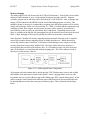
Since Dynamic C handles all memory mappings and layout details when the code is compiled,
most of the complex memory mapping scheme is hidden from the user. Rabbit instructions
access 64K memory spaces which use 16 bit address fields making a more compact code that
executes faster than using a larger address field. The figure below shows how memory is
accessed from the processor to the memory chip. A 16 bit address comes out of the processor
and a 20 bit address is created from the memory mapping unit. This 20 bit address is used to
directly access the memory chips[1].
Figure 2-2-1: Addressing Memory Components
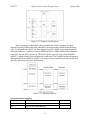
All program code and constant data is stored onto the 512K Flash memory section, and variable
data and the stack and heap are stored on the SRAM. It uses a paging scheme to access code
beyond the reach of a 16 bit address using an 8K sliding page (XPC segment and register). It also
utilizes separate I and D (Instruction and Data) spaces which results in increased data and code
by sharing addresses but not the same physical memory space. This is illustrated in the figure
below.
-2-