1
overload issue 70 february 2006
As we can see, there are choices to be made at all stages: which
XSL transform software do we use, which imaging libraries; do
we go for a stable release of Apache FOP or the development
rewrite? Do we spend money on a DocBook XML editor? Since
we have full source access for everything in the chain we might
also choose to customise the tools if they aren’t working for us.
These choices were, to start with, a distraction. I was happy to go
with the selection made by the Hibernate team unless there was a
good reason not to. I wanted the most direct route to generating
decent documentation. I kept reminding myself that content was
more important than style (even though the styling tools were
more fun to play with).
The Technical Author Departs
We continued on, then, deferring work on the documentation
until at least we had frozen the user interface, still pinning our
hopes on Word Doctor. Then the technical author left. She’d
landed a full-time editing position on a magazine.
Again, I volunteered to work on the documentation. By now the
engineering manager had succeeded in selling the idea of switching
documentation tools to higher management. It was still hard for him
to authorise me to actually write the documentation, though, since
we had just recruited a new technical support engineer, based in
North America. This engineer had nothing particular lined up for
the next couple of weeks. What better way for him to learn about
the Product than to write the user manual?
As it turned out it various delayed hardware deliveries meant it
took him a couple of weeks to set up a server capable of actually
running the Product – and then he was booked up on site visits. He
didn’t get to spend any time on documentation.
Version 1.0 was due to be released in a week’s time. We had four
choices:
● Ship with the existing documentation – which was dangerously
out of date.
● Stub out the documentation entirely, so at least users wouldn’t
be misled by it.
● Revise the Microsoft Word document, use Word Doctor to
generate HTML, reconnect the HTML to the Product.
● Rewrite the manual using DocBook.
the third choice.
So, finally, with less than a week until code freeze, I got assigned the
task of finishing the documentation using the tools of my choosing.
Problems with DocBook
Most things went rather surprisingly well, but I did encounter a
small number of hitches.
Portability
My first unpleasant surprise with the DocBook toolchain came
when I tried to generate the printable PDF output on a Windows
XP machine. Rather naively, perhaps, I’d assumed that since all
the tools were Java based I’d be able to run them on any platform
with a JVM. Not so.
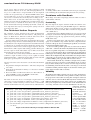
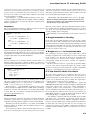
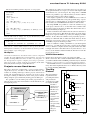
The first time I tried a Windows build, I got a two page traceback
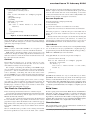
(see Figure 1) which sliced through methods in javax.media.jai,
org.apache.fop.pdf, org.apache.xerces.parsers, arriving
finally at the cause.
I had several options here: web search for a solution, raise a
query on an email list, swap out the defective component in the
toolchain, roll up my sleeves and debug the problem, or restrict the
documentation build to Linux only.
I discovered this problem quite early on, before the technical
author left – otherwise the Linux-only build restriction might have
been an acceptable compromise; several other Product components
were by now tied to Linux. (Bear in mind that the documentation
build outputs were entirely portable, it was only the build itself which
didn't work on all platforms). My actual solution was, though, another
compromise: I swapped the Java JAI [8] libraries for the more
primitive JIMI [9] ones, apparently with no adverse effects.
The incident did shake my confidence, though. It may well be
true that open source tools allow you the ultimate level of control,
but you don’t usually want to exercise it! At this stage I had only
tried building small documents with a few images. I remained
fearful that similar problems might recur when the manual grew
larger and more laden with screenshots.
Volatility
We all know that healthy software tools are in active development,
but this does have a downside. Some problems actually arose from
the progression of the tools I was using. For example, I started out
We ruled out the first choice even though it required the least with the version of the DocBook XSL stylesheets I found in the
effort. The second seemed like an admission of defeat – could Hibernate distribution (version 1.65.1). These were probably more
we seriously consider releasing a formal version of the Product than good enough for my needs, but much of the documentation I
without documentation? No-one present had any enthusiasm for was using referred to more recent distributions. In this case,
fortunately, switching
to the most recent
Caused by: java.lang.IllegalArgumentException: Invalid ICC Profile Data
stable distribution of
at java.awt.color.ICC_Profile.getInstance(ICC_Profile.java:873)
the XSL stylesheets
at java.awt.color.ICC_Profile.getInstance(ICC_Profile.java:841)
resulted
in
at java.awt.color.ICC_Profile.getDeferredInstance(ICC_Profile.java:929)
improvements all
at java.awt.color.ICC_Profile.getInstance(ICC_Profile.java:759)
round. Apache FOP
at java.awt.color.ColorSpace.getInstance(ColorSpace.java:278)
is less mature though:
at java.awt.image.ColorModel.<init>(ColorModel.java:151)
the last stable version
at java.awt.image.ComponentColorModel.<init>(ComponentColorModel.java:256)
(as of December
at com.sun.media.jai.codec.ImageCodec.<clinit>(ImageCodec.java:561)
2005) is 0.20.5 –
... 34 more
hardly a version
number to inspire
Figure 1: Traceback following an attempted build on Windows XP
confidence – and the
latest
unstable
10