1
Manual version 015
Appendix I: Theory of Operation and Functional Description
SBE 9plus
System accuracy is determined by the accuracy of the sensors and of the
crystal oscillator (master clock) used to generate the reference frequency Fr.
Fr is stable to within 1 ppm over -20 to 70 °C; time drift is less than 1 ppm for
the first year and less than 0.3 ppm per year thereafter. A five-year, worst case
master clock error budget of 3.2 ppm total yields errors in temperature of
0.00016 °C, in conductivity of 0.00005 S/m, and in pressure of 0.3 dbar.
Auxiliary Sensor Voltage Channel Range, Resolution,
and Accuracy
Up to eight voltages with the range 0 to +5 volts DC can be acquired. The
voltages are selected sequentially by a microcontroller, and digitized to 12 bits
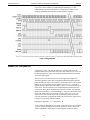
by successive approximation. The first A/D channel voltage is acquired during
an interval of approximately 50 µs at the beginning of each scan (the same time
at which counting of frequency channels begins); the second channel is
processed during the next 20 µs, etc. Differential input amplifiers followed by
2-pole Butterworth anti-aliasing filters are used in each A/D channel.
The A/D converter input range of 0 to 5 volts is converted to digital values
between 4095 and 0. The resolution at the SBE 9plus A/D input ports is
therefore 5 volts/4096 = 0.0012 volts/bit.
The Linear Tech LTC1290 A/D converter chip provides true 12-bit accuracy
without adjustment. The low-pass filters and differential amplifiers have been
designed to maintain an overall accuracy of about 0.1% over the range of
temperature encountered in ocean profiling.
Data Telemetry
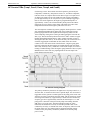
The serial data from the SBE 9plus is sent to the Deck Unit in RS-232 NRZ
format (1 start bit, 8 data bits, 1 stop bit) using a 34560 Hz carrier-modulated
differential-phase-shift-keying (DPSK) telemetry link. Phase reversals in the
data stream are detected in the Deck Unit to recreate the NRZ data.
A single chip micro controller reformats the NRZ data as required by the
Deck Unit main CPU.
SBE 9plus Power
SBE 9plus power is supplied from the Deck Unit through a single pair of
wires, usually the inner (insulated) conductor and steel jacket of a doublearmored single conductor electro-mechanical cable. A reverse-polarity
protection diode protects the 9plus from sea cable cross-wiring. The sea cable
supplies are entirely self-adjusting and require no operator attention,
irrespective of load on the 9plus or length of sea cable.
The 9plus pressure case, internal power, and sea cable voltages are electrically
isolated from one another to prevent galvanic corrosion.
The 9plus has a universal 90 – 264 VAC input; DC-to-DC converters generate
+14.3, +8, +5, and -13.5 volts. Cable current is approximately 200 milliamps
for a fully loaded (maximum auxiliary equipment) 9plus. The Deck Unit’s
250 volt DC sea cable supply can therefore drive approximately
(250 - 170V) / 200ma = 400 ohms of sea cable. However, Sea-Bird
recommends 350 ohms as the maximum overall impedance of the sea cable.
46