1
A Subgraph Operator for Graph Transformation Languages
‘green’. If we want to find all the ‘red’ nodes and the edges that connect them (but only them),
this can be done with a simple graph pattern. However, moving these ‘red’ nodes plus the edges
between them into a different model container while discarding any ‘red-green’ edges requires
a rather non-trivial sequence of operations (consisting of simple node and edge addition and
deletions).
Motivated by this and similar examples, we have developed an approach for specifying (‘selecting’) subgraphs from the result of the ‘match’ phase of the rule execution. These resulting
subgraphs can then be deleted, copied, or moved to a different part of the graph. We have implemented this feature in the context of the GReAT language. The paper revisits the GReAT
rule execution behavior, introduces the new ‘group’ concept and how it has extended the rule
execution mechanism, presents a detailed example, describes related results, and summarizes the
results and discusses potential research directions.
2
Background
The GReAT toolkit is an integrated environment for the specification and execution of model
transformations using graph transformation rules. The GReAT language is a graphical language
for specifying the transformation rules in terms of the meta-models of the source and target
languages. In this section, we will review the basics of the GReAT language.
2.1
The GReAT Language
The meta-models of the source and target languages of the transformation are specified using
UML class diagrams and added as packages in GReAT. In addition to this, GReAT allows users
to add additional packages to specify cross-domain links and temporary links using the UML
notation. Along with rule construction ingredients such as Blocks and Rules, these form the
core concepts of the GReAT language, which can be subdivided into the following three sublanguages:
• Pattern Specification Language
• Transformation Rule Language
• Sequencing and Control-Flow Language
Pattern Specification Language
The Pattern Specification Language is used to specify the graph pattern to be matched in the
host graph. The graph pattern consists of nodes and edges, which must correspond to classes
and associations from one of the existing packages. A pattern is a sub-graph in the host graph,
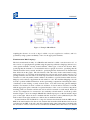
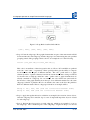
such as an association conn between two classes ClassA and ClassB contained in a class ClassC.
Figure 1 shows this pattern as seen in a GReAT rule. Such a pattern will match all associations
of type ‘conn’ between instances of classes ClassA and ClassB that are contained in a class of
type ClassC. A match binds the pattern variables classA, classB, and classC to three instances (of
the respective type) that satisfy the topological constraint expressed by the pattern. A condition
Proc. GT-VMT 2007
2 / 12