1
A Subgraph Operator for Graph Transformation Languages
are matched first.)
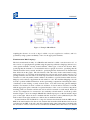
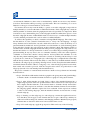
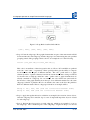
The basic unit on which a rule operates is called a packet, which consists of nodes of the
host graph to be bound to the input ports of the rule, one-to-one. When a rule fires, the pattern
matching algorithm finds the matching subgraphs in the host graph, depending on the pattern
specified in the rule. As mentioned above, a single rule execution may find multiple matches.
From our example, given a classC, there could be multiple classB and classA objects associated
via a conn, all being the children of the classC. Once these matches are found, the rule actions
are executed for each match. For each match and action execution output packets are generated
and placed at the output ports of the rule. The nodes bound to the output ports of the rule will
provide the output packet(s) of the rule, and that will subsequently function as the input packet(s)
of the next rule in the sequence of rules. In the case of the first rule, the nodes forming the input
packet are specified by the user.
Sequencing and Control Flow Language
The sequencing and control flow language allows users to compose a series of rules specified
using the transformation rule language. The sequencing allows users to connect multiple rules
in a sequence such that each rule is executed in the order determined by the direction of the
connections between the ports of the rules.
For the sake of convenience and manageability, rules can be composed in a hierarchy by
placing a set of rules in a Block or a ForBlock. When a sequence of rules is placed in a Block,
each rule processes all its input packets and then passes the produced set of output packets to
the next rule. In the case of a ForBlock, each input packet of the parent ForBlock passes through
all the rules before the next packet is processed. Blocks also allow recursion by connecting the
output of the last rule in the block to the input interface of the block.
Conditional execution of rules can be specified by using the Test and Case blocks. A Test
block contains multiple Case blocks, each specifying a desired match and a set of connected
output ports, but no CreateNew and Delete elements. The output(s) of the Cases are connected
to the output(s) of the parent Test. Each Case is tried, and the output produced by the successful
one is place on the output interface of the Test.
3
The Group Operator
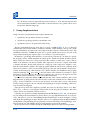
As it was discussed in section 2, our current implementation for a graph re-writing rule’s execution works in two sequential steps:
• Step 1: Find all the valid matches in the host graph for the given pattern (i.e., match the
LHS of the rule in the host graph) and the given binding for the input ports.
• Step 2: For each match, independently, apply the rule action(s). This can include deleting
elements, creating new elements, and changing attributes.
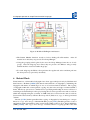
The major limitation with this algorithm is the inability to apply a single rule action across
multiple matches. After all matches are computed, the rule’s action is executed individually
Proc. GT-VMT 2007
4 / 12