1
CHAPTER 4
TSDC EXPERIMENTAL PROCEDURES
4.1 Sample Preparation
As an extremely sensitive and accurate technique, the TSDC investigation has strict
requirement for samples. The surface of solid samples should be as flat as possible to make good
contact with the electrodes. Therefore, mold for TSDC sample should have smooth surface, or
polish the contact surface of solid sample after curing. What is more, metallizing the sample
surface is highly recommended. Metallizing the sample surface can create one external electrode
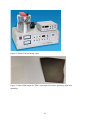
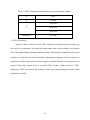
which can make better contact with TSDC cell electrodes. This can be done by sputtering.
Samples should have uniform thickness. Uneven thickness results in bad contacts, which
is one important error source for TSDC test. It may reduce the current, produce noise, or cause
additional peaks due to electrode polarization. Under the same polarizing condition, thinner
samples can be polarized at higher level. Therefore, to achieve higher polarization, the TSDC
test requires thin samples. In addition, be aware, high pressure between the electrodes is
generally not suitable to improve bad contacts. Therefore, sample should not be wrested too
tightly between two electrodes, as it can deform the sample and may damage the electrodes.
4.1.1 Sample Material
Pure epoxy and agent from Huntsman Company were used for TSDC investigation. To
investigate silica filler’s effect for epoxy on TSDC properties, we add 10% (weight present)
silica to epoxy sample to contrast with pure epoxy data.
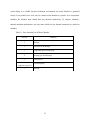
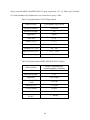
We chose MSDS ARALDITE LY 1556 US type epoxy from Huntsman Company, table
4.1 and 4.2 show the basic physical and chemical properties of MSDS ARALDITE LY 1556 US
39