1
Physics 124 · Lab 6 · Spring 2012
68
? Why does choosing the ouput impedance of one block to be much smaller than the input
impedance of the the following block ensure that the signal is not attenuated?
It is important, therefore, that we understand a little about these two types of impedance.
Theoretically, one calculates the output impedance of a circuit by connecting a wire to
the output of the device, and then imagining raising the potential on that wire by some
amount ∆V . In so doing, you will be forced to supply some additional current ∆I such
that Kirchhoff’s rules are still obeyed. The ratio ∆V /∆I is the output impedance of the
circuit.
? What is the output impedance of the power supply attached to the series 10 Mohm
resistor (Fig. 6.2)?
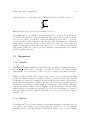
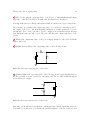
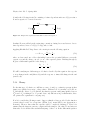
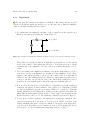
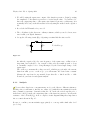
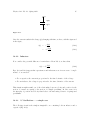
? (Slightly harder) What is the output impedance of the following circuit?
R1
+
R2
V
Figure 6.4. What is the output impedance of this circuit?
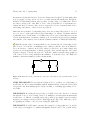
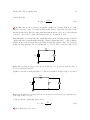
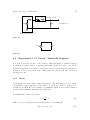
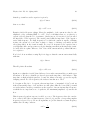
? (Similar) What is the input impedance of the following circuit? Again, imagine increasing the potential on a wire connected to the input, and discover what additional current
you would need to supply.
R1
+
V
R2
Figure 6.5. What is the input impedance of this circuit?
Curiously, you should have found that the output impedance and the input impedance are
both what you would get if you calculate the parallel resistance of the two resistors (often