1
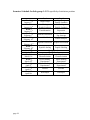
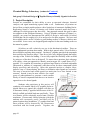
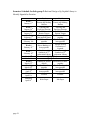
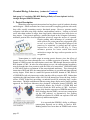
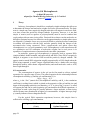
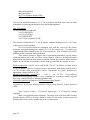
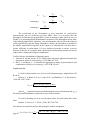
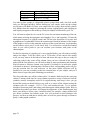
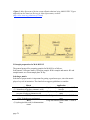
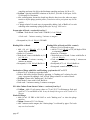
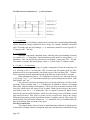
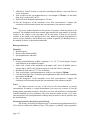
Possible electronic transitions of !, s, and n electrons
s ’ s* transitions:
An electron in a bonding s orbital can be excited to the corresponding antibonding
orbital, though the energy required for this is large. For example, methane (which has
only C-H bonds, and can only undergo s ’ s* transitions) cannot be seen in typical UVVis spectra (200 – 700 nm).
n ’ s* transitions:
Saturated compounds containing atoms with lone pairs (non-bonding electrons)
are capable of n ’ s* transitions. These transitions usually need less energy than s ’ s*
transitions. They can initiated by light whose wavelength is in the range 150 – 250 nm.
The number of organic functional groups with n ’ s* peaks in the UV region is small.
n ’ #* and # ’ #* transitions:
Most absorption spectroscopy of organic compounds is based on transitions of n
or # electrons to the #* excited state. This is because the absorption peaks for these
transitions fall in an experimentally convenient region of the spectrum (200 – 700 nm).
These transitions need an unsaturated group in the molecule to provide the # electrons.
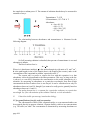
Molar absorptivities from n ’ #* transitions are relatively low, and range from 10
to 100 L.mol-1.cm-1. # ’ #* transitions normally give molar absorptivities between 1,000
and 10,000 L.mol-1.cm-1.
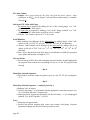
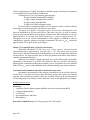
The solvent in which the absorbing species is dissolved also has an effect on the
spectrum. Peaks resulting from n ’ #* transitions are shifted to shorter wavelengths
(blue shift) with increasing solvent polarity. This arises from increased solvation of the
lone pair, which lowers the energy of the n orbital. Often (but not always), the reverse
(red shift) is seen for # ’ #* transitions. This is caused by attractive dipole forces
between the solvent and the absorber, which lower the energy levels of both the excited
and unexcited states. This effect is greater for the excited state, and so the energy
difference between the excited and unexcited states is slightly reduced. This results in a
small red shift. This effect also influences n ’ #* transitions, but is overshadowed by the
blue shift resulting from solvation of lone pairs.
The Beer-Lambert Law
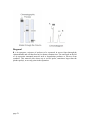
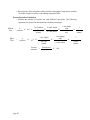
The diagram below shows a beam of monochromatic radiation of radiant power
P0 directed at a sample solution. Absorption takes place and the beam of radiation leaving
page 107