1
10.1. COMPUTATIONAL DEMANDS
209
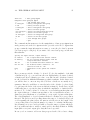
[130, 131, 127]). Note that these approximations should only be used with ansatz 2
and the SP approach (i.e. fixed geminal amplitudes).
For MP3 the approximations (F12*), and (F12) to a full F12 implementation become identical: they include all contributions linear in the coefficients ckl
ij . The
explicitly-correlated MP4 method MP4(F12*) is defined as fourth-order approximation to CCSD(F12*)(T). Note that MP4(F12*) has to be used with the SP or fixed
amplitude approache for the geminal coefficients ckl
ij . MP3(F12*) and MP4(F12*)
are currently only available for closed-shell or unrestricted Hartree-Fock reference
wavefunctions.
The CPU time for a CCSD(F12) calculation is approximately the sum of the CPU
time for an MP2-F12 calculation with the same basis sets plus that of a conventional
CCSD calculation multiplied by (1+NCABS /N ), where N is the number of basis and
NCABS the number of complementary auxiliary basis (CABS) functions (typically
NCABS ≈ 2 − 3N ). If the geminal coefficients are determined by solving Eq. (10.16)
instead of using fixed amplitudes, the costs per CCSD(F12) iteration increase to
≈ (1 + 2NCABS /N ) the costs for conventional CCSD iteration. Irrespective how the
geminal coefficients are determined, the disc space for CCSD(F12) calculations are
approximated a factor of ≈ (1 + 2NCABS /N ) larger than the disc space required
for a conventional CCSD calculation. Note that this increase in the computational
costs is by far outweighted by the enhanced basis set convergence.
In combination with the CCSD(F12*) approximation (and also CCSD[F12], CCSDF12a, CCSD-F12b, CCSD(2)F12 and CCSD(2)F12∗ ) the CPU time for the SP approach is only about 20% or less longer than for a conventional CCSD calculation
within the same basis set.
CC calculations with restricted open-shell (ROHF) references: The MP2
and all CC calculations for ROHF reference wavefunctions are done by first transforming to a semi-canonical orbital basis which are defined by the eigenvectors of
the occupied/occupied and virtual/virtual blocks of the Fock matrices of alpha and
beta spin. No spin restrictions are applied in the cluster equations. This approach
is sometimes also denoted as ROHF-UCCSD.
Note that if a frozen-core approximation is used, the semicanonical orbitals depend on whether the block-diagonalization of the Fock matrices is done in space
of all orbitals or only in the space of the correlated valence orbitals. The two approaches lead thus to slightly different energies, but none of two is more valid or
more accurate than the other. The ricc2 program uses the former scheme with the
block-diagonalization done in the space of all molecular orbitals. The same scheme
is used e.g. in the CFOUR program suite, but other codes as e.g. the implementation
in MOLPRO use a block-diagonalization restricted to the active valence space.
Perturbative triples corrections: To achieve ground state energies a high accuracy which systematically surpasses the acccuracy MP2 and DFT calculations for
reaction and binding energies, the CCSD model should be combined with a perturbative correction for connected triples. The recommended approach for the correction