1
OLIMEX© 2015
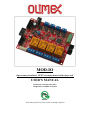
MOD-IO user's manual
CHAPTER 1: OVERVIEW
1. Introduction to the chapter
Thank you for choosing the MOD-IO extension module from Olimex! This document provides a
user’s guide for the MOD-IO board. As an overview, this chapter gives the scope of this document
and lists the board’s features. The document’s organization is then detailed.
The MOD-IO board allows easy expansion of the functionality of other boards by adding relays,
optocouplers and analog inputs.
MOD-IO is an open-source, open-hardware project and all documentation is available to the
customer.
1.1 Features
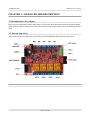
The board has the following set of features:
•
•
•
•
•
•
•
•
•
•
•
•
•
•
•
•
•
Open source hardware board with ATMega16L-8AU microcontroller
4-optocoupler isolated inputs with screw terminals
Input status LEDs
4-relay outputs with 5A/250VAC contacts with screw terminals
Output status LEDs
Stackable
ICSP 5×2 pin connector for in-circuit programming with AVR-ISP500 and AVR-ISP-MK2
or another compatible ICSP programmer
JTAG 5×2 pin connector for in-circuit programming with AVR-JTAG, AVR-JTAG-USB or
another compatible JTAG debugger
EXT extension connector for the unused AVR ports
Status LED
Reset IC ZM33064
Quartz crystal oscillator circuit 8MHz
DC-DC with input voltage 8-30VDC – this board can be powered from 24V industrial
power supplies
Power plug-in jack
Four mounting holes 3.3 mm (0.13")
FR-4, 1.5 mm (0.062"), red soldermask, white silkscreen component print
Dimensions 80×100 mm (3.9×3.15")
1.2 Target market and purpose of the board
The Olimex boards that carry the “MOD-” prefix in their product name are typically extension
boards with a UEXT connector. They are usually used to expand the functions of a “host board”
(another board with main microcontroller of its own and UEXT connector).
UEXT is a board to board connector which supports three serial communication interfaces - I2C,
SPI and RS232. It is a great way to expand the features of the development boards you already
Page 5 of 30