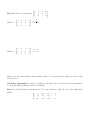
1
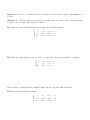
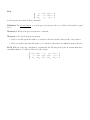
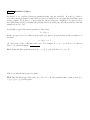
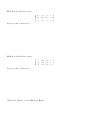
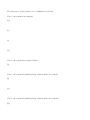
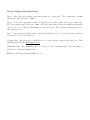
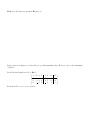
Fact 1 (scaling operation) If we replace an equation in a linear system by a nonzero multiple of the equation, the solution set remains unchanged. Ex.2 Let 2x1 −4x2 +2x3 = 0 0 2x2 −8x3 = 8 I. −4x1 +5x2 +9x3 = −9 and x1 −2x2 +x3 = 0 x2 −4x3 = 4 , I . −4x1 +5x2 +9x3 = −9 00 then both I0 and I00 are equivalent to I. In other words, systems I, I0 , and I00 are essentially the same. Notation: Fact 2 (interchange operation) If we interchange two equations in a system, the solution set remains unchanged. Ex.3 Consider x1 −2x2 +x3 = 0 I . −4x1 +5x2 +9x3 = −9 , 2x2 −8x3 = 8 000 then I000 is equivalent to I. Notation: Fact 3 (replacement operation) If we replace one equation in a system by the sum of itself and a multiple of another equation, the solution set remains unchanged. Ex.4 The system +x3 = 0 x1 −2x2 2x2 −8x3 = 8 I(iv) . −3x2 +13x3 = −9 is obtained by replacing Notation: of system I by of I. Definition Three operations described above are called elementary row operations. Thus elementary row operations do NOT alter the solution set of the original system.