1
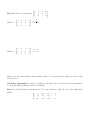
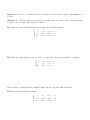
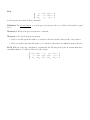
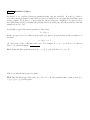
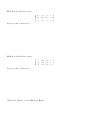
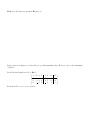
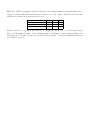
So, how to change a general x1 −2x2 2x2 −4x1 +5x2 x1 −−−−−−−−→ system to a triangular one? Let’s take system I as an example. +x3 = 0 +x3 = 0 x1 −2x2 −8x3 = 8 −−−−−−−−→ 2x2 −8x3 = 8 +9x3 = −9 −3x2 +13x3 = −9 −2x2 +x3 = 0 x1 −2x2 +x3 = 0 x2 −4x3 = 4 −−−−−−−−→ x2 −4x3 = 4 . −3x2 +13x3 = −9 x3 = 3 It is easy to find the solution to the last system: x3 = , x2 = , x1 = Now let’s describe the process above in terms of the augmented matrices: .. . 1 −2 1 . 0 1 −2 1 .. 0 .. . 0 2 −8 . 8 −−−−−−−−→ 0 2 −8 .. 8 .. .. −4 5 9 . −9 0 −3 13 . −9 −−−−−−−−→ .. . .. . .. . −−−−−−−−→ .. . .. . .. . . . From the last matrix, we recover a system x1 −2x2 +x3 = 0 x2 −4x3 = 4 x3 = 3 and the solution of this new system is exactly the same as what we met before. Remark This method is called the Gauss-Jordan elimination. Definition Two matrices are row equivalent if there is a sequence of elementary row operations that transforms one matrix into the other. Ex.5 Solve the system III. x2 −4x3 = 8 2x1 −3x2 +2x3 = 1 . 5x1 −8x2 +7x3 = 1 .. 0 1 −4 . 8 . 2 −3 2 .. 1 −−−−−−−−→ . 5 −8 7 .. 1