1
5.2 Controlling, control output
You can select in the controller ON/OFF or PID controlling for heating as well as for cooling. If PID controlling is set, you
can use the autotuning of PID parameters, see page10.
The parameters for configuration of the control output 1 are in configuration level, menu out1.
ON/OFF controlling
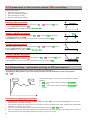
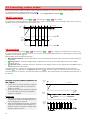
ON/OFF control is selected by setting ot1 = ht2 (for heating) or ot1 = CL2 (for cooling).
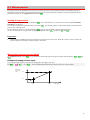
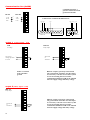
It is used for less exacting application. It is not possible to achieve zero hysteresis value on principle. The process value rises
and drops about set point value in the characteristic way.
Stp value
Procees
value
hysteresis
time
State of
control
output
ON
OFF
time
PID controlling
PID control is selected by setting ot1 = ht (for heating) or ot1 = CL (for cooling). It provides the precise control. For
the correct function of the controller, however, it is necessary to set properly PID parameters. Autotunning for setting of PID
parameters is described on page 10.
PID parameters have the following meaning:
• Pb1 proportional band is set in measured units. It is the band about the set point value in which the controller keeps the
temperature.
• It1 integral factor, in minutes. Integral factor compensates the loss of system. A low integral value causes a fast
integrating action.
• dE1 derivative factor, in minutes. Derivative responses to fast changes and tries to react against them. The more value is,
the more derivative factor reacts.
The required power is (given in %) transferred to the output with so called pulse width modulation. In each time cycle
(parameter Ct1 , you will find it in configuration level, menu out1) the control output is switched ON once and once OFF.
The more the power is necessary, the wider the width of switching is. The output responses are illustrated in the third part of
the drawing.
Example of pulse width modulation of
the output:
•
•
Time cycle is 10 seconds, the power requested
is 30%. The output is ON for 3 seconds and
OFF for 7 seconds.
Time cycle is 10 seconds, the power requested
is 5%. The output is ON for 0,5 second and
OFF for 9,5 seconds.
Process
value
STP value
Time
Output
power
100 %
Important:
•
•
The duration of time cycle has the influence on
the quality of control. The longer the cycle is,
the less the quality of control is.
If the electromechanical unit (relay, switching
contactor) is used for the control output, the
duration of time cycle must be set longer with
regard to lifetime of switch.
Time
State of
control
output
ON
OFF
Time
Time cycle
16