1
Appendix
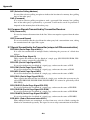
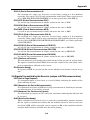
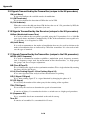
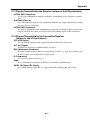
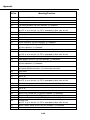
NSC (Non-Standard Command)
It is used in polling mode to request the other party to send the data. It is for a ITU-T
recommendation non-standard function (not part of DTC and a function unique to a specific manufacturer) and is used to inform the other party of the modes of reception that
may currently be used. It is for an ITU-T non-standard function, and includes a user name
and a maker code. (It is the same as NSF in terms of particulars.)
CIG (Calling Subscriber Identification)
It is used during polling reception to indicate to the other party the telephone number of
the calling machine.
DTC (Digital Transmission Command)
It is used for polling reception, and is an ITU-T standard function, informing the other
party the modes of reception that may currently be used. It is an ITU-T standard function
signal, and indicates the size of recording paper, speed of transmission, MTT, method of
coding, and recording resolution. (It is the same as DIS in terms of particulars.)
CFR (Confirmation to Receive)
It is used to indicate that TCF has been received correctly, and the machine is ready for
reception.
FTT (Failure to Train)
It is used to indicate that TCF was not received correctly.
MCF (Message Confirmation)
It is used to indicate that an image signal has been received correctly. At the same time, it
also indicates that the machine is ready to receive the next document.
RTN (Retrain Negative)
It is used to indicate that more than a specific number of errors occurred in the received
image, and the page in question was not received correctly. If there is another document
in the transmitter, the procedure is returned to DCS, and training is started once again for
transmission of the next document.
RTP (Retrain Positive)
It is use to indicate that errors occurred in the received image, but not as many as specified. Unlike RTN, the page in question is considered to have been received normally. If
there is another document in the transmitter, the procedure is retuned to DCS, and training is started once again for transmission of the next document.
PIN (Procedure Interrupt Negative)
It is used to indicate that the image signal was not received correctly, and the operator
must answer the talk reservation call if the transmission must continue. If transmission
must continue without operator involvement, the transmitter must return to DCS for transmission of the next document.
PIP (Procedure Interrupt Positive)
It is used to indicate that the image signal has been received correctly but the operator
must answer the talk reservation call if the transmission must continue. If transmission
must continue without operator involvement, the transmitter must return to DCS for transmission of the next document.
A-7


![取扱説明書[PDF:4.3MB]](http://vs1.manualzilla.com/store/data/006552141_2-6fd3fdf3ac0583a92c844693b198c134-150x150.png)
![ウェブブラウザ取扱説明書[PDF:541.4KB]](http://vs1.manualzilla.com/store/data/006614548_2-0209a95d758bb803bc6c578866930723-150x150.png)
![ライブビューワ取扱説明書[PDF:493.1KB]](http://vs1.manualzilla.com/store/data/006698008_2-588483502c13a112816087a276197b95-150x150.png)
![AGIVEN PROGRAM ]](http://vs1.manualzilla.com/store/data/005708142_1-ae1c6d6b32e7a9016e2dede042b38772-150x150.png)