1
Higher Precision in Oscilloscope
Measurements of Very Short Time Intervals
Incorporating electronic counter circuits in a delta-time
oscilloscope enables 100-ps resolution in measurements of
clock phasing, propagation delay and other digital system
timing parameters.
by Ronald C. Westlund
A substantial increase in the precision of oscillo
scope measurements of very short time intervals was
made possible by Hewlett-Packard's development of
the dual-delayed sweep in 1973. The first oscillo
scope to use this concept, the Hewlett-Packard Model
1722A,1 incorporated a microprocessor to measure
the voltage difference between selected points on the
horizontal sweep waveform and convert the reading
to time. The measurement is made quickly, unam
biguously, and with a significant improvement in
accuracy over earlier oscilloscope techniques. This
technique, now commonly known as the delta-time
ONE CONSEQUENCE OF THE explosive growth
of digital electronics is a definite need for
means of making precise measurements of very short
time intervals. It is by knowing timing parameters
such as propagation delays, clock phasing, the time
skew of control signals through gates, and the set-up
and hold times of memory cells that the digital design
engineer can determine the maximum clock rate at
which his system will operate reliably. Higher pre
cision in these timing measurements reduces the
error margins that must be allowed for, permitting
faster clock rates.
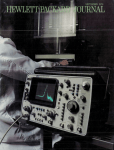
Fig. 1. Model 1743 A is a
general-purpose, dual-channel,
100-MHz oscilloscope that has the
capability of measuring very short
time intervals with 100-ps
resolution. By using a crystalcontrolled oscillator as a time re
ference, and averaging readings,
Model T 743 A provides the most
accurate time-interval measure
ment capability available in real
time oscilloscopes.
11
© Copr. 1949-1998 Hewlett-Packard Co.