1
AIR CONDITIONING 18-7
c.
INLET
PIPE
HAS
ACCUMULATION-Accumulator
warmer; proceed as in Step b above.
FROST
surface
SERVICE PROCEDURES
Before attempting any service which requires opening
of refrigerant lines or components, the person doing the
work should be thoroughly familiar with the information
under HANDLING REFRIGERANT- 12, HANDLING
REFRIGERANT LINES AND FITTINGS AND
MAINTAINING CHEMICAL STABILITY I N THE
REFRIGERATION SYSTEM. Very carefully follow the
DISCHARGING, ADDING OIL, EVACUATING AND
CHARGING PROCEDURES FOR C.C.O.T. A/C
SYSTEMS instructions given on the following pages for the
unit being serviced.
Sealing caps should be removed from sub-assemblies
just prior to making connections for final assembly. Use a
small amount of clean 525 viscosity refrigerant oil on all tube
and hose joints. Always use new O-rings dipped in the clean
525 viscosity refrigerant oil when assembling joints. The oil
will aid in assembly and help provide a leak-proof joint.
When tightening joints, use a second wrench to hold
stationary part of connection so that a solid feel can be
attained. This will indicate proper assembly.
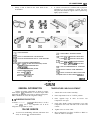
Tighten all tubing connections as shown in torque
chart (Fig. 1B-7). Insufficient or excessive torque when
tightening can result in loose joints or deformed joint parts.
Either condition can result in refrigerant leakage.
O-RING REPLACEMENT
When replacing O-rings on air conditioning coupled
hose assembly connections, the connection design should be
carefully identified to assure installation of the correct
O-ring.
Some connections will implement a “captive O-ring”
design connector that will use an O-ring groove to hold the
O-ring (see Figure 1B-8).
Assembly and tightening procedure is the same as the
standard O-ring design, however, the “captive O-ring”
design uses different O-rings.
HANDLING REFRIGERANT-12
Always wear goggles and wrap a clean cloth around
fittings, valves, and connections when performing work that
involves opening the refrigerant system. Always work in a
well ventilated area and do not weld or steam clean on or
near any 5ar-installed air conditioning lines or components.
CAUTION: If Refrigerant-12 should come
in contact with any part of the body, flush
the exposed area with cold water and
immediately seek medical help.
All Refrigerant-12 drums are shipped with a heavy
metal screw cap. The purpose of the cap is to protect the
valve and safety plug from damage. It is good practice to
replace the cap after each use of the drum for this same
reason.
If it is necessary to transport or carry any container of
Refrigerant-12 in a vehicle, do not carry it in the passenger
compartment.
If the occasion arises to fill a small Refrigerant-12
drum from a large one, never fill the drum completely. Space
should always be allowed above the liquid for expansion.
HANDLING OF REFRIGERANT LINES AND
FlTTl N GS
Tighten all tubing connections as shown in torque
chart (Fig. 1B-7). Insufficient or excessive torque when
tightening can result in loose joints or deformed joint parts.
Either condition can result in refrigerant leakage.
All metal tubing lines should be free of dents or kinks
to prevent loss of system capacity due to line restriction.
The flexible hose lines should never be bent to a radius
of less than four (4) times the diameter of the hose.
The flexible hose lines should never be allowed to
come within a distance of 63.5mm (2-1/2”) of the
exhaust manifold.
Flexible hose lines should be inspected regularly for
leaks or brittleness and replaced with new lines if
deterioration or leaking is found.
When disconnecting any fitting in the refrigeration
system, the system must first be discharged of all
Refrigerant- 12. Proceed very cautiously regardless of
gage readings. Open very slowly, keeping face and
hands away so that no injury can occur if there
happens to be liquid Refrigerant-12 in the line. If
pressure is noticed when fitting is loosened, allow it to
bleed off as described under DISCHARGING,
ADDING
OIL,
EVACUATING
AND
CHARGING PROCEDURES FOR C.C.O.T. A/C
SYSTEMS.
In the event any refrigerant line is opened to the
atmosphere, it should be immediately capped or taped
to prevent entrance of moisture and dirt, which can
cause internal compressor wear or plugged lines, in the
condenser and evaporator core and expansion (orifice)
tubes or compressor inlet screens.
The use of the proper wrenches when making
connections on O-ring fittings is important. The
opposing fitting should always be backed up with a
wrench to prevent distortion of connecting lines or
components. When connecting the flexible hose
connections, it is important that the swaged fitting and
the flare nut, as well as the coupling to which it is
attached, be held at the same time using three (3)
different wrenches to prevent turning the fitting and
damaging the ground seat.
O-rings and seats must be in perfect condition. A burr
or piece of dirt may cause a refrigerant leak. When
replacing the O-ring, first dip it in clean 525 viscosity
refrigeration oil.
Where steel to aluminum connections are being made,
use torque for aluminum tubing (see Fig. 1B-7).
MAINTAINING CHEMICAL STABILITY IN THE
REFR IG ERATI0N SYSTEM
The efficient operation and life of the air conditioning
system is dependent upon the chemical stability of the
refrigeration system. When foreign materials, such as dirt,
air, or moisture, contaminate the refrigeration system, they
will change the stability of the Refrigerant-12 and 525
viscosity compressor oil. They will also effect
pressure-temperature relationship, reduce efficient operation
and possibly cause interior corrosion and abnormal wear of
moving parts.
The following general practices should be observed to
insure chemical stability in the system:
1. Before disconnecting a refrigerant connection, wipe
,away any dirt or oil at and near the connection to
reduce the possibility of dirt entering the system. Both
sides of the connection should be capped, plugged or