1
Reported by KEITH CORNETT
Reprinted from December 17, 2007
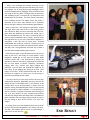
Three years ago car restorers Bill Connell and Joel Lauman
got a lead on a rare 1957 Corvette that was parked inside a
barn on a pig farm outside of Trenton, Ohio. The two were
familiar with the history of the car and its original owner Bill
Howe, a local car dealer who raced the car in 1957. While
Connell was convinced that this car was a true airbox
Corvette, it wasn’t until they were able to make the deal
and bring the partially disassembled car back to the shop
where upon further inspection it turned out to be the first
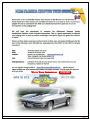
airbox Corvette produced by Chevrolet.
Before we get into the details of what makes an airbox
Corvette so rare, let’s go back to 1957 when small town
Chevy dealer Bill Howe first got the Corvette. The story goes
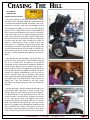
that Bill and a friend flew from Ohio to the Corvette factory
in St. Louis where they picked it up on May 16, 1957. They
then drove the car straight through back to Middletown,
Ohio. They stopped for a couple of hours of sleep and then
they drove through the night to Cumberland, Maryland
where they arrived just in time to compete in an amateur
SCCA event against some of the best known racers of the
day. In the end, Bill Howe and his number “4007″ Corvette
came in third place.
Fast forward to present time. As Bill and Joel began work
on the Corvette, they brought in noted Corvette historian
and Chevy V8 fuel-injection expert Ken Kayser who spent
two days researching the Corvette, upon which he
proclaimed that the 1957 Corvette was indeed an original
airbox Corvette and more importantly, was the pilot car
from which only 43 were produced.
So what is an airbox Corvette? I had never heard the term
before so I posed my question to the Corvette Forum’s C1C2 section where the resident expert on airbox Corvettes
“DZAUTO” schooled me on the following:
All fuel injected 57 Vettes have an air cleaner attached
directly to the air meter. Fuel injection units do not like
heat, and all of the 57 FI engines (except 43) drew in hot air
coming directly from the HOT engine compartment. The 43
Fuel Injected cars which were built with an “Airbox” in 1957
had a somewhat crude, practically hand laid up, fiberglass
duct work attached to the left inner fender and a hole was
cut into the left side of the radiator support to allow air into
the duct work. All of these 43 cars were built with heavy
duty everything (translate factory built race car), brakes,
suspension, special steering, NO radio, NO heater, wide
wheels, tachometer mounted (clamped) on the steering
column, fuel injection, HD shocks and that about covers it.
Somewhere along the line, the term “Airbox” was tagged to
these 43 cars, and it stuck.
Finally, there is a bit of a mystery surrounding the airbox
option. For many years the option was known as RPO 579E
and in fact The Corvette Black Book shows that 43 Corvettes
had the 283 ci FI engine option at an additional cost of
$726.30. However in Ken Kayser’s book entitled The History
of GM’s Ramjet Fuel Injection on the Chevrolet V-8 and its
Corvette Racing Pedigree, he states that the real airbox
option was actually 579D, an RPO not listed in the Black
Book. Corvette Forum’s DZAUTO has read Kayser’s book and
says the author seems to have a pretty convincing argument
based on the research of GM’s archives on the subject.
Regardless of the airbox option’s RPO codes and how
many may have been produced, what’s worth remembering
about this story is the fact that an ultra rare Corvette with a
unique racing history was found partially disassembled in a
barn and was brought back to life by two guys with a
passion for both Corvettes and local automotive history.
Sources:
Middletown Journal
Corvetteforum.com
Issue Number 6 * October - December 2014