1
Heinrichs Messtechnik
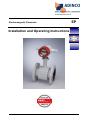
EP Installation and Operating Instructions
Introduction
This installation and operating manual explains how to operate, install and perform maintenance on the
flowmeter. Please read the manual carefully before installing the device and putting it into operation. The
manual does not apply to non-standard versions or applications.
All devices are thoroughly tested and checked for order compliance prior to shipping. Upon receipt of the
device, check it for shipping damage.
If any problem comes to light, contact our head office in Cologne. Please describe the problem and
indicate type and serial number of the device. We extend no guarantee of any kind for repair work that is
undertaken without notifying us in advance of the intention to carry out such work. Unless otherwise
agreed, any part or component for which a claim is lodged is to be sent to us for examination.
1
1.1
Safety advisories
Installation, commissioning, operating personnel
Mechanical and electrical installation, as well as commissioning, maintenance and
operation, are to be realized solely by qualified personnel that are authorized by the
installation operator to perform such work. All such personnel must read and understand
the content of the applicable operating instructions before working with the device.
In general, follow the conditions and provisions applicable in your country.
Please take note of the technical data on the rating plate and the safety advisories in the
Operating Instructions of the corresponding transmitter!
1.2 Intended purpose
The electromagnetic flowmeter is to be used solely for measuring the volume flow of liquids, suspensions
and pastes with a conductivity 5 µS/cm ( 20 µS/cm demineralized cold water). The manufacturer
accepts no responsibility for any damage or loss resulting from any other use or from improper use.
Heinrichs Messtechnik extends no express or implied warranty in regard to the applicability of the present
document for any purpose other than that described herein.
Before using corrosive or abrasive fluids, the operator must test the resistance of all wetted materials.
We will be happy to assist you in testing the corrosion resistance of wetted parts (for special fluids
including cleaning fluids). However, sole responsibility for ensuring that the device is used in accordance
with the manufacturer’s recommendations rests with the system operator. Minor changes of temperature,
concentration or the degree of contamination in the process may cause changes in corrosion resistance.
The manufacturer accepts no responsibility for any damage with respect to corrosion resistance of wetted
materials in a certain application.
1.3 Packaging, storaging, transport
Be careful not to damage the device while unpacking it. The device should be stored in a clean, dry room
until it is installed so as to prevent particulate matter from entering the device. Make certain that the
ambient temperature in the room in which the device is stored lies within the prescribed range.
Check to ensure that the technical product data indicated on the delivery note is consistent with the
stipulated requirements. If, after the device is unpacked, it is sent elsewhere to be installed, the original
packaging and transport protection inserts should be used.
1.4 Returning the device for repair and servicing
Note: According to German waste disposal legislation, it is the owner’s or customer’s responsibility to
dispose of hazardous waste. Thus, any devices sent to us for servicing, including their crevices and
cavities, must be devoid of any such material.
When sending a device for repair, please confirm your compliance with this regulation in writing. In the
event any hazardous material is detected on or inside any device sent to us for servicing, we reserve the
right to bill the customer for the cost of disposing of such material (see Section 13 “Decontamination
certificate”).
Page 4 of 30