1
Minimally, two things are required to ensure reliable reception and transmission:
Channel insertion loss: the maximum signal loss or signal attenuation allowed over
the transmission medium from the transmitting device to the receiving device. The term
‘channel’ defines the end-to-end transmission medium between transmitter and receiver.
The signal loss consists of the cumulative losses in the optical fiber cabling and in each
connection or splice.
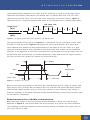
Signal dispersion: As we will discuss, the light pulses have a tendency to spread out as
they are traveling along the fiber optical link due to dispersion. The spreading must be
limited to prevent the pulses from running together or overlapping at the receiving end.
Both of these parameters – channel loss and signal dispersion – play a critical role in establishing reliable and error-free transmission. Dispersion cannot be measured in the field.
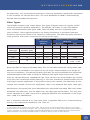
The network standards define a maximum channel length for an optical fiber channel; the
maximum length is a function of data rate and the bandwidth rating of the optical fiber.
The bandwidth rating, in turn, is based on laboratory measurements to characterize the
modal dispersion in multimode optical fibers.
Loss
Loss or attenuation has been a well-established performance parameter in the cabling
and network application standards. The signal must arrive at the end of the fiber optic
link – the input to the detector at the receiving device – with sufficient strength to be
properly detected and decoded. If the detector cannot clearly “see” the signal, transmission certainly has failed.
Attenuation or signal loss in optical fiber is caused by several intrinsic and extrinsic
factors. Two intrinsic factors are scattering and absorption. The most common form of
scattering, called ‘Rayleigh Scattering’, is caused by microscopic non-uniformities in the
optical fiber. These non-uniformities cause rays of light to partially scatter as they travel
along the fiber core and thus some light energy is lost. Rayleigh scattering is responsible
for roughly 90% of the intrinsic loss in modern optical fibers. It has a greater influence
when the size of the impurities in the glass is comparable to the wavelength of the light.
Longer wavelengths are therefore less affected than shorter wavelengths and longer wavelengths are subject to less loss than the shorter wavelengths.
Extrinsic causes of attenuation include cabling manufacturing stresses and bends in the
fiber. Bends can be distinguished in two categories: microbending and macrobending.
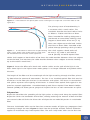
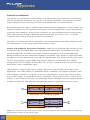
Microbending is caused by microscopic imperfections in the geometry of the fiber resulting
from the manufacturing process such as rotational asymmetry, minor changes in the core
diameter, or rough boundaries between the core and cladding. Mechanical stress, tension,
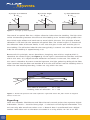
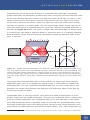
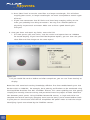
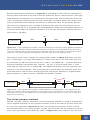
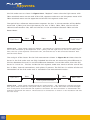
pressure or twisting of the fiber can also cause microbending. Figure 6 depicts microbending in a fiber and its effect on the light path.
6